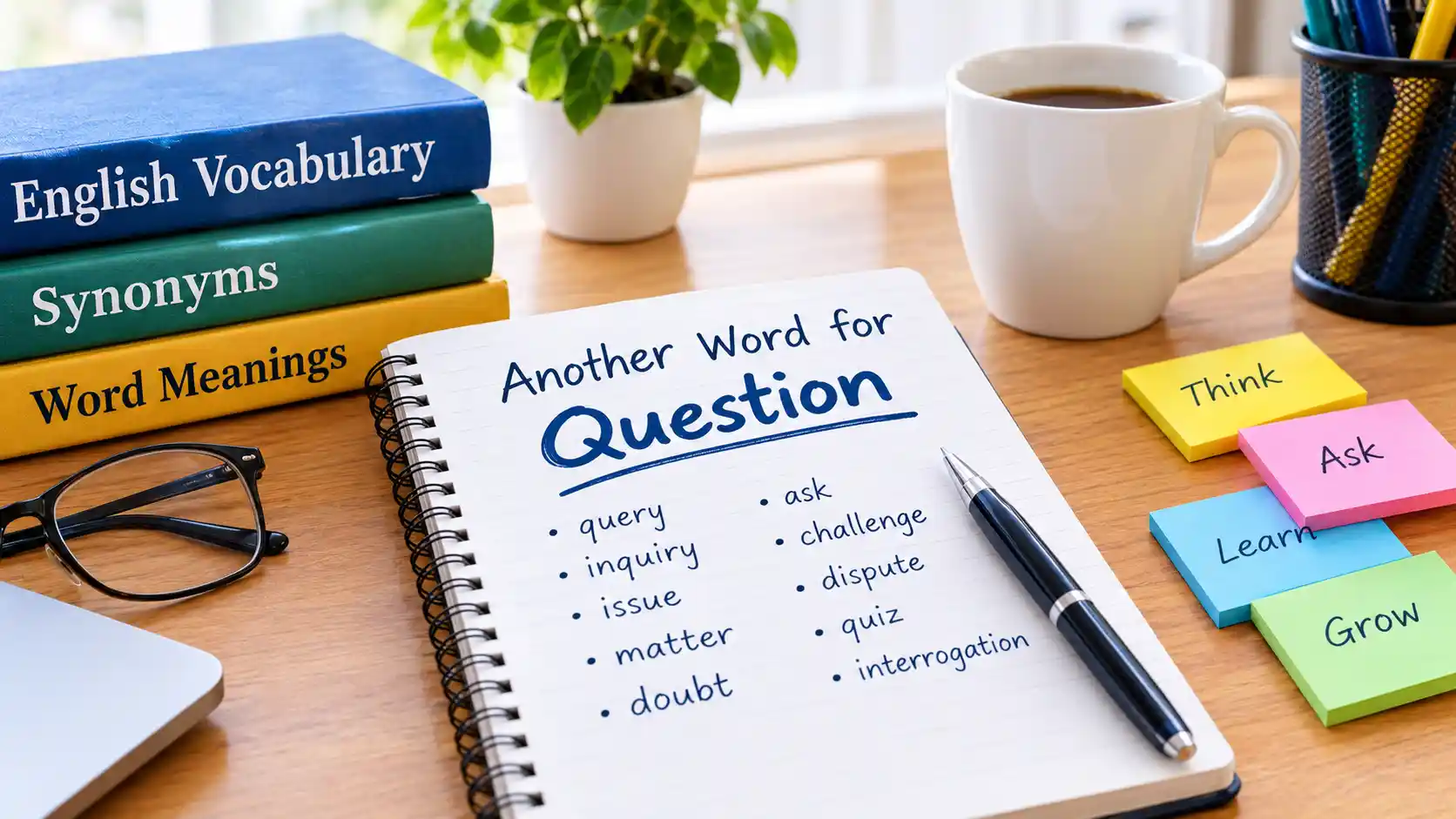
The closest everyday alternatives to “question” are query and inquiry. Use query for a short request for information, inquiry for a request or a formal investigation, issue or matter for a subject being discussed, and doubt for uncertainty. As a verb, “question” can be replaced by ask, challenge, or dispute.
“Question” covers several meanings: a sentence that asks for an answer, a problem to decide, a doubt, a test item, and two verb senses (to ask and to doubt). No single synonym fits all of them. The best alternative depends on which meaning you need and how formal you want to sound.
Quick list: query, inquiry, issue, matter, doubt, poser, quiz, ask, interrogation, challenge
This article looks at 30 alternatives in detail, with meanings, IPA, usage notes, example sentences, and context. It also explains how questions, queries, and inquiries differ.
At a Glance: Question Synonyms and Related Alternatives
| Alternative | Part of Speech | Meaning | Register / Tone | Ideal Context |
| query | noun, verb | a question asking for information | neutral to formal | business, customer service |
| inquiry | noun | a request for information; an investigation | neutral to formal | letters, official contexts |
| issue | noun | a subject for discussion | neutral | public and social topics |
| matter | noun | a subject needing attention | neutral | meetings, business |
| doubt | noun, verb | uncertainty; to be unsure | neutral | opinions, decisions |
| poser | noun | a difficult question | informal | quizzes, puzzles |
| quiz | noun | a short test | informal | school, trivia |
| ask | verb | to put a question to someone | neutral | everyday speech |
| interrogation | noun | close, formal questioning | formal | police, investigations |
| challenge | verb | to question whether something is right | neutral to formal | debates, decisions |
Which Word Should You Use?

| If you want to… | Use | Why |
| Ask for information in a formal or business way | query, inquiry | They sound professional and are common in writing. |
| Describe a tricky question that is hard to answer | poser, conundrum | They stress difficulty. |
| Describe a fun puzzle | riddle, brain teaser | They suggest a puzzle meant for play. |
| Describe a subject being discussed | issue, matter | They fit “the question of” phrases. |
| Express uncertainty | doubt, reservation | They describe a feeling, not something asked. |
| Describe a short test | quiz | It is the standard word for a short test. |
| Describe intense questioning by police | interrogation | It suggests close, serious questioning. |
| Say you do not accept something as true | challenge, dispute | They are stronger than “question” as a verb. |
Exploring the Multiple Meanings of “Question”
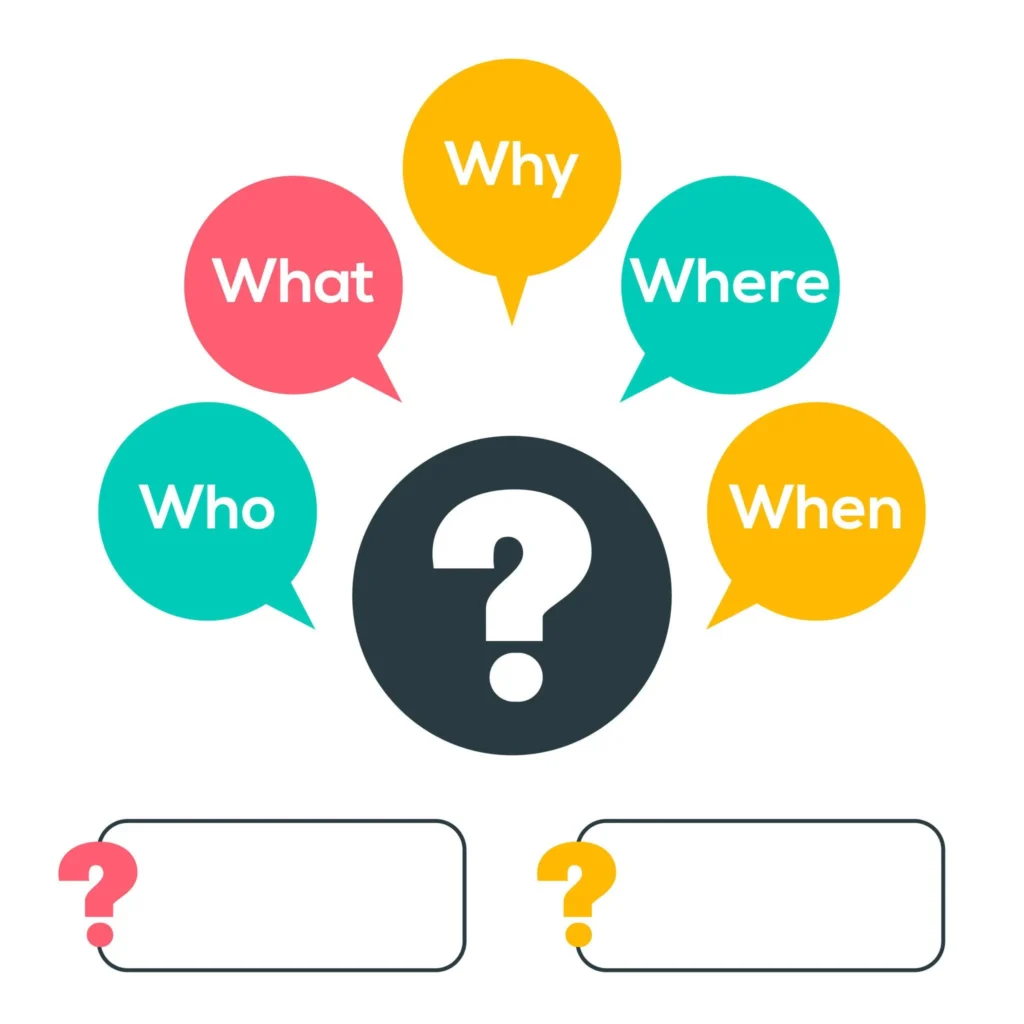
1. A Sentence That Asks for an Answer

- Meaning: Words used to ask for information or a reply.
- Explanation: This is the most common sense. Etymonline dates this sense of “an utterance meant to elicit an answer or discussion” to the early 14th century.
- Example: Can I ask you a question?
2. A Problem or Matter to Be Decided

- Meaning: A subject that needs discussion or a decision.
- Explanation: In this sense “question” often appears in phrases like the question of and the question is whether. It is more about a topic than an act of asking.
- Example: The question is whether we can afford a bigger house.
3. Doubt or Uncertainty

- Meaning: A reason to doubt something.
- Explanation: This sense appears in phrases like there is no question that and beyond question. Etymonline notes that the Old French question already meant “difficulty, problem” and Middle English used it for “a doubt.”
- Example: There is no question that she worked hard.
4. An Item on a Test
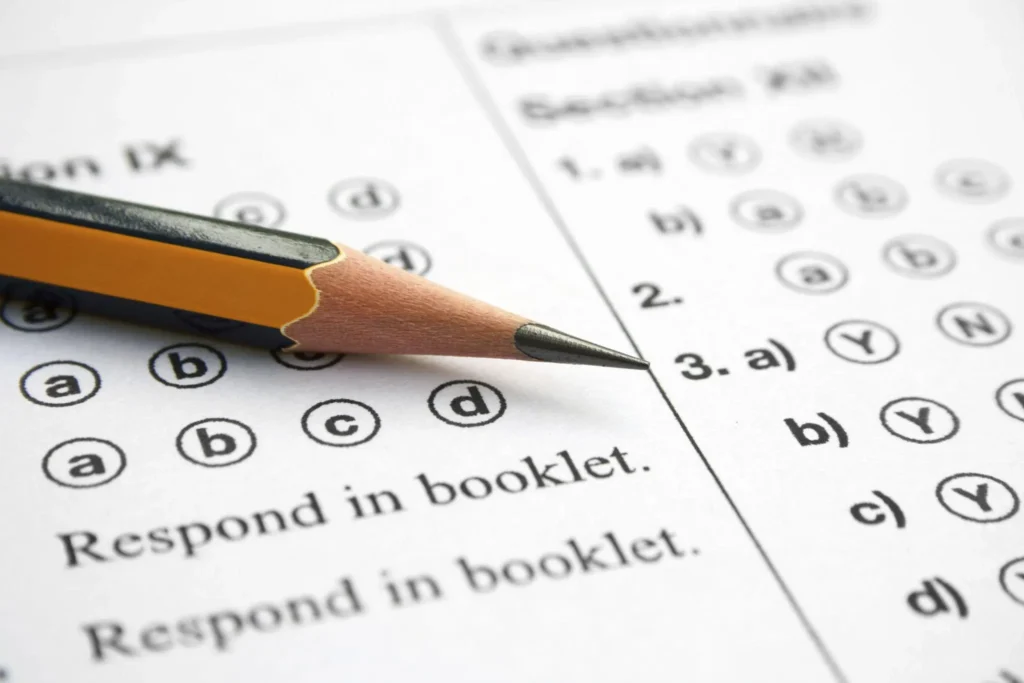
- Meaning: A single question in an exam, quiz, or survey.
- Explanation: It is usually numbered or labeled (Question 5, exam question).
- Example: Question five was the hardest on the exam.
5. To Ask Someone Questions (Verb)

- Meaning: To ask a person questions, often formally or closely.
- Explanation: As a verb, “question” is usually followed by a person (question the witness). Etymonline dates the verb to the late 15th century.
- Example: The police questioned the witness for an hour.
6. To Doubt or Challenge (Verb)

- Meaning: To express doubt about something or to dispute it.
- Explanation: This sense is about the idea, not the person. It often suggests a critical or careful attitude.
- Example: She questioned the results of the study.
Analyzing 30 Question Alternatives in Detail
Some of these words are direct synonyms of “question” in one sense, and others are related alternatives for a narrower context. The Usage notes make clear which is which.
Core Noun Synonyms

1. Query
IPA: US /ˈkwɪri/ · UK /ˈkwɪəri/
Definition: A question, especially one asking for information or expressing doubt.
- Usage: A close synonym for the “asking” sense. It is neutral to formal and common in business, customer service, and computing. It is also a verb.
- Example: I sent a query to customer service about my order.
2. Inquiry
IPA: US /ɪnˈkwaɪri/ · UK /ɪnˈkwaɪəri/ (British spelling often enquiry)
Definition: A request for information; also, a formal investigation.
- Usage: A close synonym that is neutral to formal. The meaning “formal investigation” is separate from “question.”
- Example: The company received many inquiries about the new phone.
3. Interrogation
IPA: /ɪnˌtɛrəˈɡeɪʃən/ (US and UK)
Definition: The act of questioning someone closely, especially by police.
- Usage: A related, formal alternative. It does not fit ordinary questions, because it suggests close, serious questioning. Etymonline records interrogation in the late 14th century with the plain meaning “a question.”
- Example: The suspect was released after a long interrogation.
Puzzling or Difficult Questions
4. Poser
IPA: US /ˈpoʊzər/ · UK /ˈpəʊzə/
Definition: A difficult question or problem.
- Usage: A related, informal alternative. It stresses that the question is hard to answer.
- Example: The last question on the quiz was a real poser.
5. Riddle
IPA: /ˈrɪdəl/ (US and UK)
Definition: A question or statement with a hidden answer, asked as a puzzle.
- Usage: A related, playful alternative. It is not a normal request for information.
- Example: The teacher gave us a riddle whose answer was a clock.
6. Conundrum
IPA: /kəˈnʌndrəm/ (US and UK)
Definition: A confusing and difficult problem or question.
- Usage: A related alternative for hard practical or moral problems, not simple questions.
- Example: Finding affordable housing is a conundrum for many young families.
7. Brain teaser
IPA: US /ˈbreɪn ˌtiːzər/ · UK /ˈbreɪn ˌtiːzə/
Definition: A puzzle that is hard to solve.
- Usage: A related, informal alternative for puzzles meant to be fun.
- Example: He solved the brain teaser in five minutes.
Issues and Matters Up for Discussion
8. Issue
IPA: /ˈɪʃuː/ (US and UK)
Definition: A subject or problem for discussion or concern.
- Usage: A close alternative to the “problem to decide” sense (the question of funding). It is neutral and common for public topics. “Issue” has many other meanings.
- Example: Climate change is a major issue for voters.
9. Matter
IPA: US /ˈmætər/ · UK /ˈmætə/
Definition: A subject or situation that needs attention.
- Usage: A related, neutral alternative. It fits phrases like a matter of time and a matter for the courts.
- Example: It is only a matter of time before the bridge is repaired.
10. Problem
IPA: US /ˈprɑbləm/ · UK /ˈprɒbləm/
Definition: Something difficult that needs to be solved.
- Usage: A related alternative that stresses difficulty. It is more negative than “question.”
- Example: The main problem is how to pay for it.
11. Topic
IPA: US /ˈtɑpɪk/ · UK /ˈtɒpɪk/
Definition: A subject of discussion or writing.
- Usage: A related, neutral alternative. It names the subject, not the doubt or problem.
- Example: The topic of the meeting was road safety.
12. Dilemma
IPA: /dɪˈlɛmə/ (US and UK)
Definition: A situation that requires a difficult choice between options.
- Usage: A related alternative. It suggests two or more unpleasant choices, so it is narrower than “question.”
- Example: She faced a dilemma: stay in her job or move abroad.
Doubt and Uncertainty

13. Doubt
IPA: /daʊt/ (US and UK)
Definition: A feeling of uncertainty; as a verb, to be unsure about something.
- Usage: A close alternative to the “doubt” sense in both noun and verb forms. A doubt is a feeling, not a question you ask.
- Example: I have no doubt that she will win.
14. Uncertainty
IPA: US /ʌnˈsɜrtənti/ · UK /ʌnˈsɜːtənti/
Definition: The state of being unsure.
- Usage: A related, neutral to formal alternative. It is broader than “doubt” and can describe a whole situation.
- Example: There is uncertainty about the date of the meeting.
15. Reservation
IPA: US /ˌrɛzərˈveɪʃən/ · UK /ˌrɛzəˈveɪʃən/
Definition: A feeling of doubt or unwillingness about something.
- Usage: A related, polite alternative, usually plural (reservations about). It differs from the meaning “a booking.”
- Example: I have reservations about the plan.
16. Misgiving
IPA: /ˌmɪsˈɡɪvɪŋ/ (US and UK)
Definition: A feeling of doubt or worry about something.
- Usage: A related, formal alternative, often plural. It suggests an uneasy feeling.
- Example: She signed the contract despite some misgivings.
Test and Exam Questions
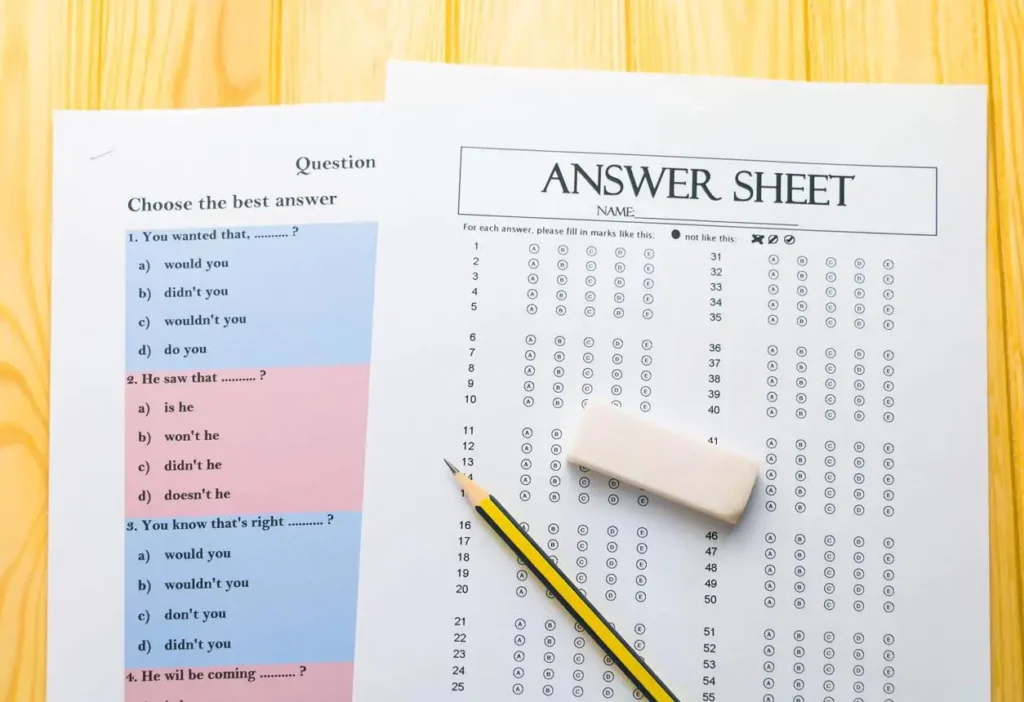
17. Quiz
IPA: /kwɪz/ (US and UK)
Definition: A short test of knowledge.
- Usage: A related, informal alternative. It names the whole test, not one question.
- Example: We have a spelling quiz on Friday.
18. Prompt
IPA: US /prɑmpt/ · UK /prɒmpt/
Definition: A question or statement that tells someone what to write or talk about.
- Usage: A related alternative used in teaching and writing tasks.
- Example: The essay prompt asked students to describe a hero.
19. Item
IPA: /ˈaɪtəm/ (US and UK)
Definition: A single question or task on a test.
- Usage: A related, technical alternative used in education (test item).
- Example: The test has forty items.
Verbs for Asking Questions

20. Ask
IPA: US /æsk/ · UK /ɑːsk/
Definition: To put a question to someone.
- Usage: The closest everyday synonym for the verb “question.” It is simple and neutral.
- Example: She asked me where the station was.
21. Inquire
IPA: US /ɪnˈkwaɪər/ · UK /ɪnˈkwaɪə/ (also spelled enquire)
Definition: To ask for information.
- Usage: A close, formal alternative. It is often followed by about.
- Example: I am writing to inquire about the job.
22. Interview
IPA: US /ˈɪntərvjuː/ · UK /ˈɪntəvjuː/
Definition: To ask someone questions, especially for a job or the news.
- Usage: A related alternative for planned, structured questioning.
- Example: The reporter interviewed the mayor.
23. Examine
IPA: /ɪɡˈzæmɪn/ (US and UK)
Definition: To question someone formally, especially a witness.
- Usage: A related, legal alternative. In everyday English, “examine” more often means to look closely.
- Example: The lawyer examined the witness about the accident.
24. Cross-examine
IPA: US /ˌkrɔs ɪɡˈzæmɪn/ · UK /ˌkrɒs ɪɡˈzæmɪn/
Definition: To question a witness closely in court to test their evidence.
- Usage: A related, legal alternative that is also used figuratively for hard questioning.
- Example: The lawyer cross-examined the witness for an hour.
25. Grill
IPA: /ɡrɪl/ (US and UK)
Definition: Informal. To question someone closely and for a long time.
- Usage: A related, informal alternative that suggests pressure. It also means to cook on a grill.
- Example: Reporters grilled the minister about the budget.
26. Probe
IPA: US /proʊb/ · UK /prəʊb/
Definition: To investigate by asking questions.
- Usage: A related alternative that suggests deeper, careful questioning, often probe into.
- Example: The committee probed the cause of the failure.
Verbs for Doubting or Challenging
27. Challenge
IPA: /ˈtʃælɪndʒ/ (US and UK)
Definition: To question whether something is right or true.
- Usage: A close alternative to “question” meaning to doubt. It is stronger and more direct. It can also mean to invite someone to compete.
- Example: She challenged the decision in court.
28. Dispute
IPA: /dɪˈspjuːt/ (US and UK)
Definition: To argue that something is wrong or untrue.
- Usage: A related, formal alternative that is stronger than “question.” It shows open disagreement.
- Example: The company disputes the claim.
29. Distrust
IPA: /dɪsˈtrʌst/ (US and UK)
Definition: To have no trust in someone or something.
- Usage: A related alternative, usually about people or motives. It is stronger than “question” and suggests suspicion.
- Example: Many voters distrust the promises.
30. Contest
IPA: /kənˈtɛst/ (US and UK)
Definition: To argue against something or challenge it, especially formally.
- Usage: A related, formal alternative for legal or political settings. As a noun, “contest” means a competition.
- Example: He plans to contest the result.
Question vs. Query vs. Inquiry: What Is the Difference?
These words overlap, but each has a typical use.
| Word | Focus | Typical Tone | Example |
| question | anything asked, or a matter to decide | neutral | I have a question about the rules. |
| query | a short request for information | neutral to formal | Please send your query by email. |
| inquiry | a request for information; a formal investigation | formal | The inquiry lasted two years. |
| interrogation | close, serious questioning | formal | The interrogation took six hours. |
| issue | a subject for discussion | neutral | Housing is a key issue. |
| doubt | a feeling of uncertainty | neutral | I have doubts about the plan. |
Question and Opposite/Paired Word Pairs
| Word | Paired Word | Note |
| question | answer | The main pair. |
| question | reply, response | Close partners of “answer.” |
| question | statement | A grammar contrast between asking and telling. |
| question | certainty | A contrast for the “doubt” sense. |
| open question | closed question | An open question needs a full answer, and a closed one needs a short answer. |
| direct question | indirect question | Where is he? versus I wonder where he is. |
| questioner | respondent | The person who asks and the person who answers. |
“Answer” is the true opposite for the asking sense. For the doubt sense, certainty is the closest contrast.
Common Word Partners of “Question”
| Pattern | Common Partners | Example |
| verb + question | ask, answer, raise, pose, dodge | She posed a question to the panel. |
| adjective + question | good, tough, simple, burning, open, leading, loaded | That is a good question. |
| noun + question | exam, interview, trick, essay, survey | The interview question surprised him. |
| question of + noun | time, money, trust, whether | It is a question of time. |
| question + noun | mark, time, word, tag | A question word like where starts the sentence. |
| follow-up question | follow-up question | The teacher asked a follow-up question. |
Idiomatic Phrases Featuring “Question”

1. Out of the Question
- Meaning: Not possible or not allowed. Etymonline dates this expression to about 1700.
- Example: Going on holiday this year is out of the question.
2. No Questions Asked
- Meaning: Without needing to explain or give reasons. Etymonline dates this to 1879, from newspaper ads for lost or stolen items.
- Example: The store offers a refund, no questions asked.
3. Beg the Question
- Meaning: Traditionally, to argue in a circle by assuming the point you are trying to prove. In everyday use, many people use it to mean “raise the question.”
- Example: Saying a book is great because it is the best begs the question.
4. Call Into Question
- Meaning: To cast doubt on something.
- Example: The new evidence calls the results into question.
Sources: Merriam-Webster; Dictionary.com; Etymonline
Word Formation of “Question”
Etymology & Structure
“Question” came into English from Anglo-French questiun and Old French question (“question, difficulty, problem; legal inquest, interrogation, torture”), and directly from Latin quaestionem (“a seeking, a questioning, inquiry, examining, judicial investigation”). Etymonline describes the Latin noun as a noun of action from the past-participle stem of quaerere (“ask, seek”). Dictionary.com gives the structure as the Latin stem quaes- plus the suffix -tiōn-. The word query comes from the same Latin verb.
Date and History
Etymonline dates the noun to the early 13th century, with the meaning “philosophical or theological problem.” The sense “utterance meant to elicit an answer or discussion” is from the early 14th century. Other dates include:
- A question of (“a dispute about”): early 15th century
- No question (“undoubtedly”): mid-15th century
- Question (verb): late 15th century
- Questioner: early 15th century
- Questioning and questionable: 1600
- In question (“under discussion”): 1610s
- Out of the question: about 1700
- Question mark: 1849
- Questionnaire: 1901
Word Class Variations
- Noun: question, questions
- Verb: question, questions, questioned, questioning
- Adjective: questionable, unquestionable
- Adverb: questionably, unquestionably
- Related nouns: questioner, questionnaire
Common Word-Choice Mistakes
- Make a question to the teacher: use ask the teacher a question.
- I have a doubt about the homework: use I have a question about the homework (a doubt is a feeling of uncertainty).
- She asked me a question: she asked me a question.
- It is out of question: use out of the question.
- I want to ask a question about the rules: use I want to ask a question about the rules.
- He is a questionable student who asks many things: use inquisitive (questionable means doubtful).
- The company interviewed me for the job: use interviews.
Frequently Asked Questions
What is the closest synonym for “question”?
Query and inquiry are the closest nouns for the act of asking. As a verb, ask is the closest.
What is a formal alternative to “question”?
Inquiry and query are formal nouns. Inquire and examine are formal verbs.
What is the difference between a question and a problem?
A question is something you ask or need to answer. A problem is a difficulty that needs to be solved, though the two overlap in phrases like a question of money.
What is the difference between a question and a doubt?
A question is something you ask. A doubt is a feeling of uncertainty that may or may not lead to a question.
What is another word for “question” as a verb meaning to ask?
Ask, inquire, interview, and examine all work. Choose by situation: interview for planned questioning and examine for legal settings.
What is another word for “question” meaning to doubt?
Challenge, dispute, distrust, and contest all work. They are stronger than “questions.”
What is another word for a difficult question?
Poser, conundrum, and brain teaser all fit. Riddle fits a puzzle with a hidden answer.
What is another word for a question on an exam?
Items and prompts are common in education. A short test is a quiz.
What is the opposite of “question”?
The answer is the usual opposite. In grammar, a statement is the contrast.
What does “in question” mean?
It means “under discussion or consideration,” as in the man in question. Etymonline dates this use to the 1610s.
Conclusion
The closest everyday alternatives to “question” are query and inquiry. For a subject under discussion, issue and matter fit best. For uncertainty, doubt is the clearest choice, and for the verb, ask, challenge, and dispute cover the two main senses.
Context matters because “question” covers asking, deciding, doubting, testing, and challenging. A word that fits one meaning can fail in another. Poser describes a hard question but not a worry, and interrogation is too strong for an ordinary request.
To choose the right alternative, first decide what kind of “question” you mean: an asked question, a matter to decide, a doubt, a test item, or a verb. Then match the word to your tone: casual, neutral, or formal.
Sources: Merriam-Webster; Collins Thesaurus

Haleema Sadia is an experienced content writer with three years of expertise in English vocabulary, synonyms, and word meanings. At TrueVisite, she creates clear, accurate, and reader-friendly content that helps people expand their vocabulary, understand word usage, and communicate with greater confidence. Her goal is to make learning English simple, practical, and accessible to everyone.