

The closest everyday alternatives to “autonomy” are independence, freedom, self-government, and self-determination. Use independence for freedom from outside control, self-government for the political sense, self-determination for the right to decide for oneself, and discretion or latitude for freedom to decide at work.
“Autonomy” covers several areas: a region or country governing itself, a person making their own choices, freedom to decide at work, moral and medical self-direction, and machines working without human control. No single synonym fits all of them. The best alternative depends on who or what is self-governing and how much freedom you mean.
Quick list: independence, freedom, self-government, self-determination, agency, discretion, latitude, sovereignty, home rule, self-reliance
This article looks at 30 alternatives in detail, with meanings, IPA, usage notes, example sentences, and context. It also explains how autonomy, independence, sovereignty, and self-determination differ.
At a Glance: Autonomy Synonyms and Related Alternatives
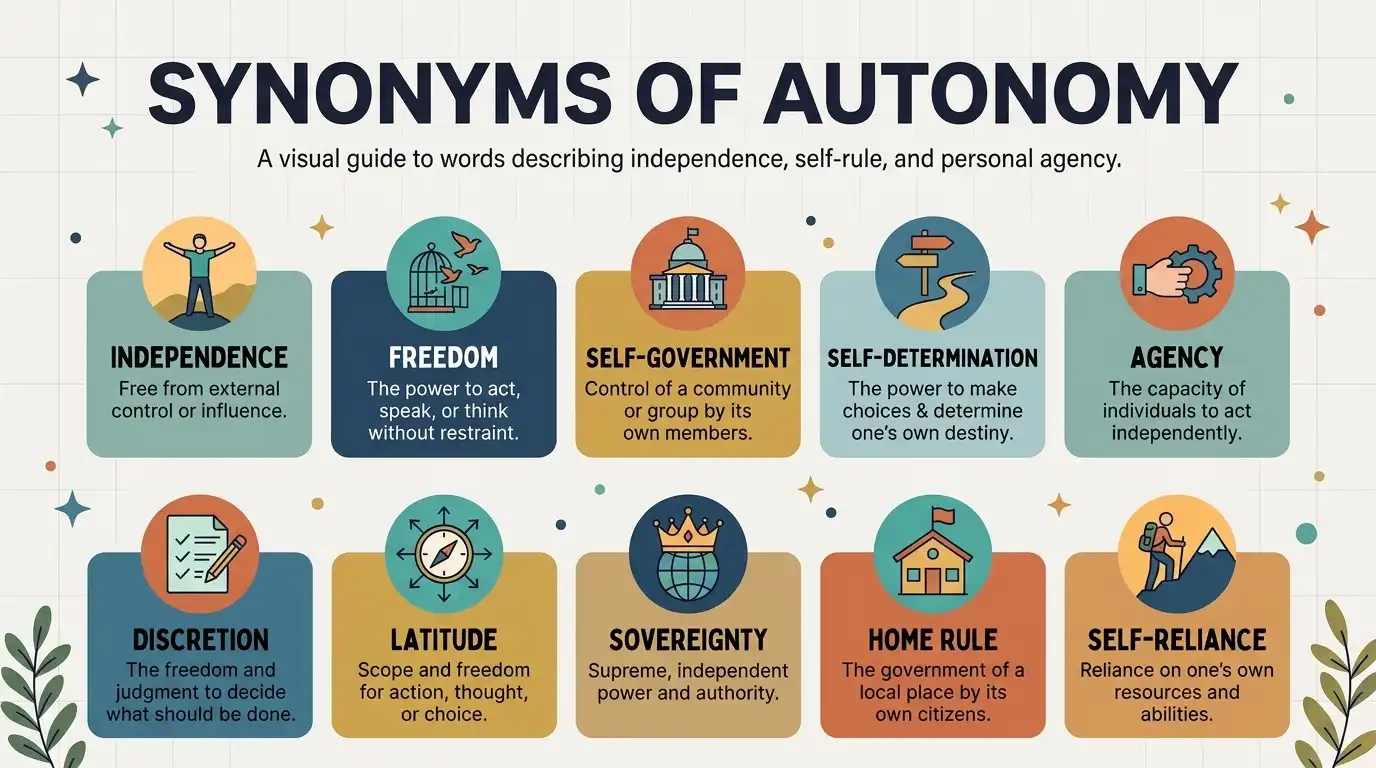
| Alternative | Part of Speech | Meaning | Register / Tone | Ideal Context |
| independence | noun | freedom from outside control | neutral | people, countries |
| freedom | noun | the power to act without being controlled | neutral | general use |
| self-government | noun | government by one’s own people | formal | politics |
| self-determination | noun | the right to decide for oneself | formal | politics, ethics |
| agency | noun | the ability to act and make choices | formal | psychology, social science |
| discretion | noun | freedom to decide what to do | formal | work, law |
| latitude | noun | freedom to act or choose | formal | work, education |
| sovereignty | noun | supreme power of a state | formal | law, politics |
| home rule | noun | local self-government | formal | politics |
| self-reliance | noun | relying on one’s own abilities | neutral | personal life |
Which Word Should You Use?
| If you want to… | Use | Why |
| Describe a region governing itself inside a country | home rule, devolution, self-government | They name the political arrangement. |
| Describe a country’s complete freedom | independence, sovereignty | They suggest full, not partial, freedom. |
| Describe freedom to decide at work | discretion, latitude, leeway | They fit managers, teachers, and professionals. |
| Describe giving someone full freedom on a project | free rein, carte blanche | They show complete trust. |
| Describe a person’s ability to make their own choices | agency, free will, self-determination | They focus on personal choice. |
| Describe being able to provide for oneself | self-reliance, self-sufficiency | They stress depending on oneself. |
| Describe machines running with little human input | automation, self-regulation | They are the technical terms. |
| Describe the right to decide | prerogative, authority | They show who has the power to decide. |
Exploring the Multiple Meanings of “Autonomy”

1. Political Self-Government
- Meaning: The right or condition of a state, region, or group governing itself.
- Explanation: This is the oldest sense. Etymonline dates “autonomy” to the 1620s, first for states. A region can have autonomy without being fully independent.
- Example: The island was given greater autonomy by the central government.
2. Personal Independence
- Meaning: The ability of a person to make their own choices and direct their own life.
- Explanation: Etymonline records this use for persons from 1803. It is common in discussions of teenagers, older adults, and personal rights.
- Example: Teenagers often want more autonomy from their parents.
3. Freedom to Decide at Work
- Meaning: The freedom to decide how to do one’s job or tasks.
- Explanation: This sense is common in business and management. It does not mean freedom from all rules.
- Example: Good managers give employees autonomy over how they do their tasks.
4. Moral and Medical Self-Direction
- Meaning: The ability to govern oneself by one’s own reasoning and values.
- Explanation: In philosophy, Etymonline notes the Kantian sense of “the Will giving itself its own law, based on conscience.” In medicine, it means a person’s right to make decisions about their own care.
- Example: Respect for autonomy is a key rule in medical ethics.
5. Self-Operation in Systems
- Meaning: The ability of a machine or system to work without human control.
- Explanation: This modern sense appears with robots and vehicles. The related adjective is autonomous.
- Example: The robot works with a high level of autonomy.
Analyzing 30 Autonomy Alternatives in Detail
Some of these words are close synonyms of “autonomy,” and others are related alternatives that fit one area. The Usage notes make clear which is which.
Core Synonyms
1. Independence
IPA: /ˌɪndɪˈpɛndəns/ (US and UK)
Definition: Freedom from outside control; the ability to manage on one’s own.
- Usage: The closest synonym. It is neutral and broader than “autonomy.” For countries, it suggests complete freedom, while autonomy can be partial.
- Example: The young woman valued her independence.
2. Freedom
IPA: /ˈfriːdəm/ (US and UK)
Definition: The power or right to act, speak, or think without being controlled.
- Usage: A close but broader synonym. It does not suggest self-governing within rules the way “autonomy” does.
- Example: Remote work gives me the freedom to plan my day.
3. Self-government
IPA: US /ˌsɛlf ˈɡʌvərnmənt/ · UK /ˌsɛlf ˈɡʌvənmənt/
Definition: Government of a country or region by its own people.
- Usage: A close, formal synonym for the political sense.
- Example: The island voted for greater self-government.
4. Self-rule
IPA: /ˌsɛlf ˈruːl/ (US and UK)
Definition: The same as self-government; rule by one’s own people.
- Usage: A close synonym that is a little less formal than “self-government.”
- Example: The movement fought for self-rule.
5. Self-determination
IPA: US /ˌsɛlf dɪˌtɜrməˈneɪʃən/ · UK /ˌsɛlf dɪˌtɜːmɪˈneɪʃən/
Definition: The right of people to decide their own political status; free choice of one’s own actions.
- Usage: A close, formal synonym for both the political and personal senses.
- Example: Many nations have called for the right to self-determination.
Personal Independence
6. Agency
IPA: /ˈeɪdʒənsi/ (US and UK)
Definition: The ability to act and make one’s own choices.
- Usage: A related alternative used in psychology and social science. It is about personal power to act, not about government.
- Example: Giving students a choice builds their sense of agency.
7. Free will
IPA: /ˌfriː ˈwɪl/ (US and UK)
Definition: The ability to make choices that are not controlled by fate or others.
- Usage: A related alternative for philosophical or religious discussion.
- Example: Philosophers argue about whether humans have free will.
8. Self-direction
IPA: /ˌsɛlf dɪˈrɛkʃən/ (US and UK)
Definition: The act of guiding oneself without outside control.
- Usage: A close alternative for personal and workplace autonomy. It is common in education and psychology.
- Example: The course rewards self-direction.
9. Self-reliance
IPA: /ˌsɛlf rɪˈlaɪəns/ (US and UK)
Definition: Reliance on one’s own judgment and abilities.
- Usage: A related alternative that stresses depending on oneself, not the right to decide.
- Example: Life on the farm taught her self-reliance.
10. Self-sufficiency
IPA: /ˌsɛlf səˈfɪʃənsi/ (US and UK)
Definition: The ability to supply one’s own needs without outside help.
- Usage: A related alternative for practical independence, such as food or energy.
- Example: The village aims for self-sufficiency in food.
Freedom at Work
11. Discretion
IPA: /dɪˈskrɛʃən/ (US and UK)
Definition: The freedom to decide what should be done in a situation.
- Usage: A close, formal alternative for the workplace sense. “Discretion” also means tactful secrecy, which has a different meaning.
- Example: Managers have discretion over small expenses.
12. Latitude
IPA: US /ˈlætətuːd/ · UK /ˈlætɪtjuːd/
Definition: Freedom to act or choose, often with few strict rules.
- Usage: A related, formal alternative. It is also a geographic term.
- Example: The teacher gave students latitude in choosing topics.
13. Leeway
IPA: /ˈliːweɪ/ (US and UK)
Definition: Extra room or freedom to act.
- Usage: A related alternative that suggests a small amount of freedom.
- Example: The deadline gave us some leeway.
14. Free rein
IPA: /ˌfriː ˈreɪn/ (US and UK)
Definition: Complete freedom to act as one wishes.
- Usage: A related alternative that is stronger and is also an idiom (give free rein).
- Example: The director gave the designer free rein.
15. Carte blanche
IPA: US /ˌkɑrt ˈblɑnʃ/ · UK /ˌkɑːt ˈblɑːnʃ/
Definition: Full freedom to do as one thinks best.
- Usage: A related, formal alternative borrowed from French. It suggests complete trust.
- Example: The chef was given carte blanche to design the menu.
16. Empowerment
IPA: US /ɪmˈpaʊərmənt/ · UK /ɪmˈpaʊəmənt/
Definition: The act of giving someone the power or authority to do something.
- Usage: A related alternative for the process of giving autonomy, not the condition itself.
- Example: Training programs focus on employee empowerment.
Political and Territorial Alternatives
17. Sovereignty
IPA: US /ˈsɑvrənti/ · UK /ˈsɒvrɪnti/
Definition: The supreme power or authority of a state to govern itself.
- Usage: A related, formal alternative that is stronger and legal. It means full authority, while “autonomy” can be partial.
- Example: The treaty respects the sovereignty of each country.
18. Home rule
IPA: US /ˌhoʊm ˈruːl/ · UK /ˌhəʊm ˈruːl/
Definition: Self-government of a region or country by its own people.
- Usage: A related, political alternative for local self-government within a larger state.
- Example: Supporters demanded home rule for the province.
19. Devolution
IPA: US /ˌdɛvəˈluʃən/ · UK /ˌdiːvəˈluːʃən/
Definition: The transfer of power from a central government to local ones.
- Usage: A related alternative for the process that creates autonomy, not the autonomy itself.
- Example: Devolution gave the region control over its schools.
20. Liberty
IPA: US /ˈlɪbərti/ · UK /ˈlɪbəti/
Definition: The state of being free from unfair control.
- Usage: A related, formal alternative for political and personal freedom.
- Example: The constitution protects personal liberty.
21. Emancipation
IPA: /ɪˌmænsɪˈpeɪʃən/ (US and UK)
Definition: The act of freeing someone from legal, social, or political restrictions.
- Usage: A related, formal alternative. It describes the act of becoming free, not the ongoing state of self-government.
- Example: The emancipation of the workers changed the town.
Economic and System Independence
22. Autarky
IPA: US /ˈɔtɑrki/ · UK /ˈɔːtɑːki/
Definition: National economic self-sufficiency.
- Usage: A related, rare, and formal alternative for economics. It does not apply to personal autonomy.
- Example: The country tried to follow a policy of autarky.
23. Self-regulation
IPA: /ˌsɛlf ˌrɛɡjəˈleɪʃən/ (US and UK)
Definition: Control of a system, group, or person by itself, without outside rules.
- Usage: A related alternative for industries, systems, and personal control.
- Example: The industry relies on self-regulation.
24. Automation
IPA: /ˌɔːtəˈmeɪʃən/ (US and UK)
Definition: The use of machines to do work with little human control.
- Usage: A related alternative for the technology sense. It is not about the right to self-govern.
- Example: Automation has changed how factories work.
Choice and Responsibility
25. Free choice
IPA: /ˌfriː ˈtʃɔɪs/ (US and UK)
Definition: The ability to decide for oneself.
- Usage: A related, plain alternative for personal decisions.
- Example: Voters have free choice at the ballot box.
26. Individualism
IPA: /ˌɪndəˈvɪdʒuəlɪzəm/ (US and UK)
Definition: The belief in the importance of individual freedom and self-reliance.
- Usage: A related alternative that names a belief or culture, not a person’s condition.
- Example: The writer praised individualism.
27. Initiative
IPA: /ɪˈnɪʃətɪv/ (US and UK)
Definition: The ability to act without being told what to do.
- Usage: A related alternative for the workplace. It describes the person’s drive, not the permission they have.
- Example: She showed initiative by fixing the problem herself.
28. Prerogative
IPA: US /prɪˈrɑɡətɪv/ · UK /prɪˈrɒɡətɪv/
Definition: A right or privilege to decide or act that belongs to a person or group.
- Usage: A related, formal alternative that names who holds the right to decide.
- Example: Choosing the team is the coach’s prerogative.
29. Authority
IPA: US /əˈθɔrəti/ · UK /ɔːˈθɒrəti/
Definition: The power or right to make decisions.
- Usage: A related alternative. It focuses on who has the power to decide, not on freedom from control.
- Example: The committee has the authority to approve the plan.
30. Ownership
IPA: US /ˈoʊnərʃɪp/ · UK /ˈəʊnəʃɪp/
Definition: In business, the feeling of full responsibility for a task or project.
- Usage: A related alternative in the workplace sense. It also means legally owning something, which has a different meaning.
- Example: The team takes ownership of the project.
Autonomy vs. Independence vs. Sovereignty vs. Self-Determination
These four words overlap, but each has a different focus.
| Word | Focus | Typical Context | Example |
| autonomy | self-governing, often within a larger system | regions, workplaces, ethics | The region has some autonomy. |
| independence | freedom from outside control | people, countries | The country won its independence. |
| sovereignty | supreme legal authority of a state | law, international relations | The treaty protects sovereignty. |
| self-determination | the right to choose one’s own status or actions | politics, ethics | The people claimed self-determination. |
A region can have autonomy without independence, because it can govern itself while remaining part of a larger country. Sovereignty is the strongest term, because it means full legal authority.
Autonomy and Opposite/Paired Word Pairs
| Word | Paired Word | Note |
| autonomy | dependence | The direct opposite for both personal and political senses. |
| autonomy | control | The opposite when someone else makes the decisions. |
| autonomy | micromanagement | A workplace opposite, where a manager checks every detail. |
| autonomy | heteronomy | The philosophical opposite: being ruled by outside forces. |
| autonomy | accountability | A common management pair: freedom paired with responsibility. |
| autonomy | responsibility | Autonomy usually comes with responsibility for choices. |
Common Word Partners of “Autonomy”

| Pattern | Common Partners | Example |
| adjective + autonomy | personal, political, financial, full, limited, regional | The college has financial autonomy. |
| verb + autonomy | have, give, grant, gain, lose, respect, limit | The new law grants the region more autonomy. |
| noun + autonomy | job, worker, academic, operational | Job autonomy improves how people feel at work. |
| autonomy + preposition | over, in, from, of | She wants autonomy over her schedule. |
| degree of autonomy | a high degree of, a measure of, a sense of | The team works with a high degree of autonomy. |
| autonomy and + noun | accountability, responsibility | The role offers autonomy and responsibility. |
Idiomatic Phrases Featuring “Autonomy”
“Autonomy” has no true idioms. These are established terms used in ethics, medicine, and philosophy.
1. Bodily Autonomy
- Meaning: A person’s right to make decisions about their own body.
- Example: Many medical laws are built on the idea of bodily autonomy.
2. Patient Autonomy
- Meaning: A patient’s right to make informed decisions about their own care.
- Example: Doctors must respect patient autonomy and explain all options.
3. Autonomy of the Will
- Meaning: A phrase from Kantian philosophy about the will giving itself its own law, based on conscience. Etymonline notes this Kantian sense.
- Example: The professor explained Kant’s idea of the autonomy of the will.
Word Formation of “Autonomy”
Etymology & Structure
“Autonomy” comes from Greek autonomia (“independence”), an abstract noun from autonomos (“independent, living by one’s own laws”). Etymonline explains that autonomos are formed from autos (“self”) and nomos (“custom, law”). The root nomos comes from the Proto-Indo-European root *nem- (“assign, allot; take”), which is also behind economy, astronomy, and taxonomy. In English, the structure is auto- plus -nomy.
Date and History
Etymonline dates “autonomy” to the 1620s, meaning “autonomous condition, power or right of self-government,” first used of states. Its use for persons is recorded from 1803. Other dates include:
- Autonomical: 1650s
- Autonomous: 1777, “subject to its own laws” (in translations of Montesquieu); 1780, “pertaining to autonomy”
- Autonomic: 1832, “self-governing”; mostly used in physiology since the late 19th century
Word Class Variations
- Noun: autonomy, autonomies
- Adjective: autonomous
- Adverb: autonomously
- Related adjective: autonomic (mostly about involuntary body functions)
- Opposite term: heteronomy
Common Word-Choice Mistakes
- The autonomy car: use the autonomous car.
- An autonomic vehicle: use an autonomous vehicle (autonomic mostly describes body functions).
- She wants autonomy on her decisions: use autonomy over her decisions or in decision-making.
- The company gave employees more automation: use autonomy (automation means machines doing work).
- The region gained independence but is still part of the country: use gained autonomy (it is still part of the country).
- He lost his autonomy when the boss watched every move: use his autonomy (a noun is needed).
- The country defended its sovereignty: use sovereignty.
Frequently Asked Questions
What is the closest synonym for “autonomy”?
Independence is the closest in general use. For political use, self-government is closest, and for personal use, self-direction.
Is autonomy the same as freedom?
Not exactly. “Freedom” is broader. “Autonomy” suggests the ability to govern oneself, often within a larger system or set of rules.
What is a formal alternative to “autonomy”?
Self-determination, sovereignty, and discretion sound formal. Choose by context: political, legal, or professional.
What is another word for autonomy at work?
Discretion, latitude, leeway, free rein, and empowerment all fit. Free rein and carte blanche suggest the most freedom.
What is another word for political autonomy?
Self-government, home rule, devolution, and sovereignty are used. They differ in how much power is held.
What is the opposite of “autonomy”?
Dependence and control are the usual opposites. Micromanagement is the common workplace opposite.
Can “autonomy” be used for machines?
Yes, as in an autonomous vehicle. Related technical terms include automation and self-regulation.
What is another word for personal autonomy?
Self-determination, agency, free will, and self-direction all fit. They focus on a person’s ability to choose.
What does autonomy mean in medicine?
It means a patient’s right to make decisions about their own care. The usual phrase is patient autonomy.
What are the adjective and adverb forms of “autonomy”?
The adjective is autonomous and the adverb is autonomously. Do not confuse autonomous with autonomic, which mostly describes automatic body functions.
Conclusion
The closest everyday alternatives to “autonomy” are independence, freedom, self-government, and self-determination. For work, discretion and latitude fit best, and for politics, home rule and sovereignty name the arrangement.
Context matters because “autonomy” covers politics, personal life, work, ethics, and technology. A word that fits one area can fail in another. Independence suggests complete freedom, sovereignty is a legal term, and automation is about machines, not rights.
To choose the right alternative, first decide who or what is self-governing: a region, a person, a worker, or a machine. Then match the word to your tone: casual, neutral, or formal.
Sources: Merriam-Webster; Collins English Dictionary

Haleema Sadia is an experienced content writer with three years of expertise in English vocabulary, synonyms, and word meanings. At TrueVisite, she creates clear, accurate, and reader-friendly content that helps people expand their vocabulary, understand word usage, and communicate with greater confidence. Her goal is to make learning English simple, practical, and accessible to everyone.