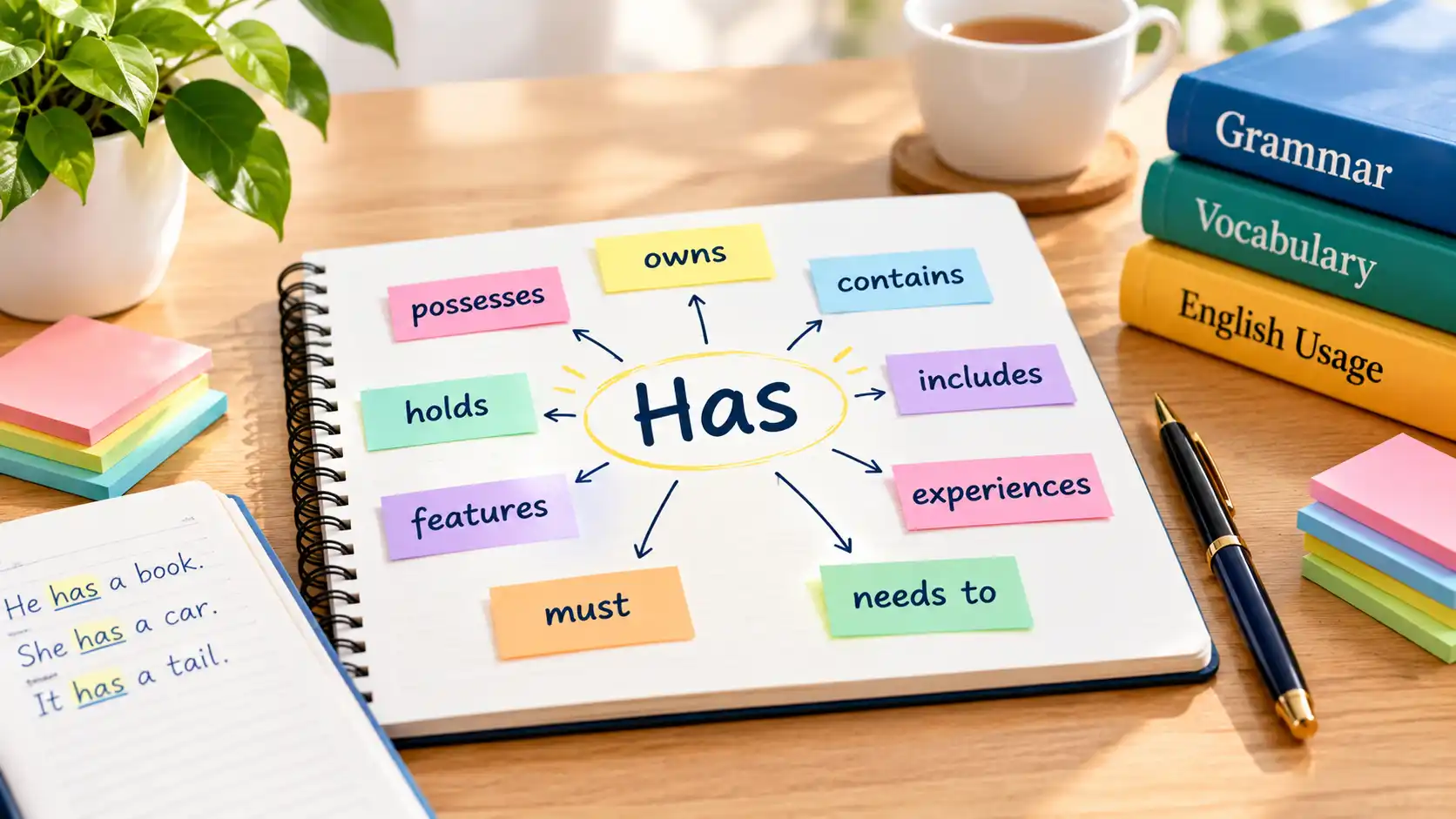
The closest everyday alternatives to “has” are owns and possesses when it means “owns,” and contains or includes when it means “has as a part.” When “has” means “must,” as in has to, use must or needs to. When it means “goes through,” use experiences.
“Has” is the third-person singular present form of “have,” one of the most flexible verbs in English. It can show ownership, contents, features, experiences, obligation, and also helps form tenses (has finished). The best alternative depends on which of these jobs “has” is doing, and as a helping verb it has no synonym at all.
Quick list: owns, possesses, holds, contains, includes, features, boasts, experiences, must, needs to
This article looks at 30 alternatives in detail, written in the same he/she/it form as “has.” Each comes with a meaning, IPA, a usage note, and an example sentence. It also explains how has, have, and had differ.
At a Glance: Has Synonyms and Related Alternatives
| Alternative | Part of Speech | Meaning | Register / Tone | Ideal Context |
| owns | verb | has as property | neutral | possessions |
| possesses | verb | owns or has as a quality | formal | skills, property |
| holds | verb | has a position or qualification | neutral to formal | jobs, degrees, records |
| contains | verb | has inside | neutral to formal | boxes, books, products |
| includes | verb | has as one part | neutral | lists, prices, packages |
| features | verb | has as an important part | neutral | products, places |
| boasts | verb | has something to be proud of | neutral | places, products |
| experiences | verb | goes through or feels | neutral | feelings, events |
| receives | verb | gets or is given | neutral to formal | mail, news, awards |
| must | modal verb | has to; is obliged to | formal | rules, strong necessity |
Which Word Should You Use?
| If you want to… | Use | Why |
| Say someone owns something | owns | It is clear and neutral. |
| Sound formal about ownership or ability | possesses | It suits legal and professional writing. |
| Say something has parts inside it | contains, includes | They show what is inside or part of the whole. |
| Describe a product’s features | features, is equipped with | They are standard words for products and rooms. |
| Praise what a place has | boasts, enjoys | They highlight good qualities. |
| Say someone goes through something | experiences, undergoes, suffers | They show this kind of experience. |
| Say someone gets something | receives, gets, obtains | They replace “has” when it means “get.” |
| Replace “has to” | must, needs to, is required to | They express necessity or obligation. |
Exploring the Multiple Meanings of “Has”
1. Owns or Possesses
- Meaning: Holds as property or as something one can use.
- Explanation: This is the most common sense. M-W includes holding something as a possession, privilege, or entitlement.
- Example: She has a small farm.
2. Contains or Includes
- Meaning: Holds or includes as a part of a whole.
- Explanation: In this sense, the subject is a thing, not a person. M-W’s examples include the car has power brakes and April has 30 days.
- Example: The book has twelve chapters.
3. Is Characterized by a Quality or Relationship
- Meaning: Shows a feature, quality, or family relationship.
- Explanation: This sense describes what someone or something is like or is connected to.
- Example: He has blue eyes and two brothers.
4. Experiences, Receives, or Takes
- Meaning: Goes through, gets, or takes something.
- Explanation: This sense covers illness, news, food, and activities. The meaning changes with the noun that follows.
- Example: She has a cold and has breakfast at seven.
5. Must or Is Obliged To
- Meaning: Needs to; is required to do something.
- Explanation: In has to, the verb shows duty. Etymonline dates “have to” meaning “must” to the 1570s. M-W notes it is usually pronounced /hæs/ in this sense.
- Example: She has to leave early.
6. Helping Verb
- Meaning: A helping verb used to form the present perfect tense.
- Explanation: It joins with a past participle, as in has finished. This use has no synonym, because it is grammar, not meaning. Etymonline notes the auxiliary use goes back to Old English.
- Example: He has finished his homework.
Analyzing 30 Has Alternatives in Detail
Some of these words are direct synonyms of “has” in one sense, and others are related alternatives for a narrower context. They are listed in the he/she/it form so you can swap them directly for “has.”
Core Synonyms for Owning
1. Owns
IPA: US /oʊnz/ · UK /əʊnz/
Definition: Has as property.
- Usage: A close synonym for the ownership sense. It is neutral and clear. It cannot replace “has” in phrases like has a cold.
- Example: She owns a small farm.
2. Possesses
IPA: /pəˈzɛsɪz/ (US and UK)
Definition: Owns or has as a quality or ability.
- Usage: A close, formal synonym for ownership and for qualities such as skills. It sounds more serious than “has.”
- Example: He possesses great skill in design.
3. Holds
IPA: US /hoʊldz/ · UK /həʊldz/
Definition: Has a position, title, or qualification.
- Usage: A related alternative for degrees, jobs, and records. It does not work for feelings or features.
- Example: She holds a degree in biology.
4. Keeps
IPA: /kiːps/ (US and UK)
Definition: Has in one’s care or continues to have.
- Usage: A related alternative for animals, items, and records. It suggests ongoing care.
- Example: He keeps bees in the garden.
5. Retains
IPA: /rɪˈteɪnz/ (US and UK)
Definition: Continues to have something.
- Usage: A related, formal alternative for something that stays unchanged.
- Example: The old building retains its original doors.
Containing and Including
6. Contains
IPA: /kənˈteɪnz/ (US and UK)
Definition: Has something inside; holds as a part.
- Usage: A close synonym for the “has as a part” sense. It stresses what is inside.
- Example: The box contains twelve pencils.
7. Includes
IPA: /ɪnˈkluːdz/ (US and UK)
Definition: Has as one part of a whole.
- Usage: A close synonym. It suggests the list may not be complete.
- Example: The price includes breakfast.
8. Comprises
IPA: /kəmˈpraɪzɪz/ (US and UK)
Definition: Is made up of; includes all the parts.
- Usage: A related, formal alternative that lists the whole. Use it without “of” (comprises six parts).
- Example: The team comprises six engineers.
9. Features
IPA: US /ˈfiːtʃərz/ · UK /ˈfiːtʃəz/
Definition: Has as an important or special part.
- Usage: A close alternative for products, places, and descriptions. It is common in advertising.
- Example: The phone features a large screen.
10. Incorporates
IPA: US /ɪnˈkɔrpəreɪts/ · UK /ɪnˈkɔːpəreɪts/
Definition: Has as a built-in part; includes.
- Usage: A related, formal alternative for ideas or parts added into a design.
- Example: The new design incorporates solar panels.
Qualities, Features, and Good Things
11. Boasts
IPA: US /boʊsts/ · UK /bəʊsts/
Definition: Has something to be proud of.
- Usage: A related alternative for places and products with good features. It differs from boasts of, which means to brag.
- Example: The city boasts three museums.
12. Enjoys
IPA: /ɪnˈdʒɔɪz/ (US and UK)
Definition: Has something good as an advantage.
- Usage: A related alternative for good conditions, such as health or weather.
- Example: The town enjoys mild weather.
13. Bears
IPA: US /bɛrz/ · UK /beəz/
Definition: Has as a mark or feature.
- Usage: A related, formal alternative, as in bears a name or bears a resemblance.
- Example: The letter bears her signature.
14. Carries
IPA: /ˈkæriz/ (US and UK)
Definition: Has as a feature or part.
- Usage: A related alternative for features such as warranties. It also means to transport, in a different sense.
- Example: The product carries a two-year warranty.
15. Sports
IPA: US /spɔrts/ · UK /spɔːts/
Definition: Informal. Wears or shows something noticeable.
- Usage: A related, informal alternative for clothing or looks. It is a little humorous.
- Example: He sports a bright red scarf.
16. Exhibits
IPA: /ɪɡˈzɪbɪts/ (US and UK)
Definition: Shows or has a quality or sign.
- Usage: A related, formal alternative for behavior or symptoms.
- Example: The patient exhibits signs of fatigue.
Experiencing and Receiving
17. Experiences
IPA: US /ɪkˈspɪriənsɪz/ · UK /ɪkˈspɪəriənsɪz/
Definition: Goes through or feels something.
- Usage: A close, neutral alternative to “has” for feelings and events.
- Example: She experiences headaches in cold weather.
18. Undergoes
IPA: US /ˌʌndərˈɡoʊz/ · UK /ˌʌndəˈɡəʊz/
Definition: Goes through something, especially treatment or change.
- Usage: A related, formal alternative to “has” for surgery, tests, or change.
- Example: He undergoes a medical check every year.
19. Suffers
IPA: US /ˈsʌfərz/ · UK /ˈsʌfəz/
Definition: Experiences something bad.
- Usage: A related alternative for illness or loss. It is always negative, and often followed by from.
- Example: She suffers from back pain.
20. Receives
IPA: /rɪˈsiːvz/ (US and UK)
Definition: Gets or is given something.
- Usage: A close, neutral to formal alternative to “has” meaning “gets.” M-W lists “receive” as one meaning of have.
- Example: He receives many emails each day.
21. Gets
IPA: /ɡɛts/ (US and UK)
Definition: Receives or obtains something.
- Usage: A close, informal alternative. It is very flexible in everyday speech.
- Example: She gets a letter from her sister every month.
22. Obtains
IPA: /əbˈteɪnz/ (US and UK)
Definition: Gets possession of something, often with effort.
- Usage: A related, formal alternative for acquiring things like permits.
- Example: He obtains a license each year.
Obligation: Alternatives to “Has To”
23. Must
IPA: /mʌst/ (US and UK)
Definition: Is required to; has to.
- Usage: A close synonym for has to. It is strong and a bit formal. It never takes -s, so use it without “has.”
- Example: She must leave early.
24. Needs to
IPA: /ˈniːdz tuː/ (US and UK)
Definition: Has to; is in need of doing something.
- Usage: A close, neutral alternative to has to that stresses necessity.
- Example: He needs to finish the report today.
25. Is required to
IPA: US /ɪz rɪˈkwaɪərd tuː/ · UK /ɪz rɪˈkwaɪəd tuː/
Definition: Has to because of a rule or law.
- Usage: A close, formal alternative to has to when the reason is a rule.
- Example: Every driver is required to wear a seat belt.
26. Is obliged to
IPA: /ɪz əˈblaɪdʒd tuː/ (US and UK)
Definition: Has to because of duty, law, or promise.
- Usage: A close, formal alternative that stresses duty.
- Example: The company is obliged to report its earnings.
Formal and Descriptive Alternatives
27. Is equipped with
IPA: US /ɪz ɪˈkwɪpt wɪð/ · UK /ɪz ɪˈkwɪpt wɪð/
Definition: Has tools, devices, or parts that are provided.
- Usage: A related alternative for machines, rooms, and vehicles.
- Example: The kitchen is equipped with a modern oven.
28. Is endowed with
IPA: /ɪz ɪnˈdaʊd wɪð/ (US and UK)
Definition: Has a natural quality or gift.
- Usage: A related, formal or literary alternative for natural abilities.
- Example: She is endowed with a strong memory.
29. Commands
IPA: US /kəˈmændz/ · UK /kəˈmɑːndz/
Definition: Has and can use something with authority, such as a skill, price, or respect.
- Usage: A related, formal alternative, as in commands a high salary or commands respect.
- Example: The artist commands high prices for her work.
30. Wields
IPA: /wiːldz/ (US and UK)
Definition: Has and uses power or influence.
- Usage: A related, formal alternative for power. It suggests the power is being used.
- Example: The mayor wields great influence.
Has, Have, and Had: Using the Right Form
Choosing between these three forms depends on the subject and the time. This table shows the pattern.
| Subject | Present | Past | Example |
| I, you, we, they, plural nouns | have | had | They have two cars. |
| he, she, it, singular nouns | has | had | She has two cars. |
| any subject (past) | had | had | He had a cold last week. |
The same pattern applies when the verb works as a helper: she has finished, but they have finished. After do, does, and did, use have, not has (does she have a pen?).
M-W notes a pronunciation detail: in has to, meaning “must,” the word is usually /hæs/, not /hæz/. British English also often uses has got for possession (she has got a car), which means the same as “has” but sounds more informal.
Has and Opposite/Paired Word Pairs
| Word | Paired Word | Note |
| has | lacks | The main opposite. Dictionary.com lists lack as an antonym of have. |
| has | does not have | The negative form. |
| has | have | The subject-agreement pair. |
| has | had | The present and past pair. |
| the haves | the have-nots | A paired noun phrase. Etymonline dates have-not, “poor person,” to 1742. |
| has | lost | A natural contrast for things once owned. |
“Lacks” is the clearest opposite for ownership and qualities. The has/have/had pairs are about grammar, not meaning.
Common Word Partners of “Has”
| Pattern | Common Partners | Example |
| has + noun (possession) | a car, a house, a job, a dog | He has a new car. |
| has + feature or quality | green eyes, a good memory, a lot of energy | She has a good memory. |
| has + time or plans | a meeting, an appointment, a deadline, time | He has a meeting at noon. |
| has + illness | a cold, a fever, a headache, the flu | She has a headache. |
| has + meal or action | breakfast, lunch, a shower, a look | He has breakfast at seven. |
| has + past participle | has been, has done, has gone | She has gone home. |
| has to + verb | leave, go, finish, decide | He has to leave early. |
Idiomatic Phrases Featuring “Has”
These expressions are used in different forms. They are established expressions that native speakers use often.
1. Has Had It
- Meaning: Is no longer working, or can no longer tolerate something. M-W includes an example of an old car that “has finally had it.”
- Example: My old laptop has finally had it.
2. Has the Last Laugh
- Meaning: Succeeds in the end, after others doubted or mocked.
- Example: Everyone laughed at his plan, but he had the last laugh.
3. Has Something Up One’s Sleeve
- Meaning: Has a secret plan or idea ready to use.
- Example: She smiled because she has something up her sleeve.
4. Has a Way With Words
- Meaning: Is skilled at speaking or writing in a clever way.
- Example: The author has a way with words.
Word Formation of “Has”
Etymology & Structure
“Has” is the third-person singular present form of the verb “have.” Etymonline traces “have” to Old English habban (“to own, possess; be subject to, experience”), from Proto-Germanic *habejanan, from the Proto-Indo-European root *kap- (“to grasp”). Cognates include Old Norse hafa, Old Saxon hebbjan, Old Frisian habba, German haben, and Gothic haban. Etymonline stresses that “have” is not related to Latin habere, despite the similar look and meaning. The Latin cognate is capere (“seize”). The archaic form hath comes from Old English hæfð, and “has” is the modern form.
Date and History
Dictionary.com says “have” was first recorded before 900. Etymonline notes that the sense “possess, have at one’s disposal” is a shift from older languages, where the thing owned was the subject. Other dates include:
- Auxiliary use (to form the present perfect): Old English
- Have to meaning “must, be obliged”: 1570s
- Have-not, “poor person”: 1742
- Have a nice day as a greeting: by 1970
Word Class Variations
- Verb: have, has, had, having
- Auxiliary verb: has (as in has finished)
- Semi-modal: has to (meaning “must”)
- Noun: the haves, have-not
- Archaic form: hath
Common Word-Choice Mistakes
- He have a car: use he has a car.
- Does she has a pen?: use does she have a pen?
- She has to go: use she has to go.
- Everyone has finished: use everyone has finished.
- She finished the work yesterday: she finished the work yesterday.
- The team comprises six engineers: use comprises six engineers.
- The hotel boasts of a pool: use the hotel boasts a pool (boasts of means to brag).
Frequently Asked Questions
What is the closest synonym for “has”?
It depends on the meaning. Owns and possesses are closest for ownership, and contains and includes are closest for parts.
What is a formal alternative to “has”?
Possesses, comprises, and is endowed with sound formal. Retains fits when something continues to be had.
What is another word for “has to”?
Must, needs to, is required to, and is obliged to all work. Choose by tone: is required to suit rules, and needs to be more casual.
What is another word for “has” meaning “contains”?
Contains, includes, and features all fit. Includes suggest the list may not be complete.
What can I use instead of “has” in business writing?
Holds works for degrees and positions, and possesses skills. Exhibits fit qualities such as leadership.
What is another word for “has” when describing a product?
Features, includes, boasts, and is equipped with are standard. Boasts are the most promotional.
What is the difference between “has” and “have”?
“Has” goes with he, she, it, and singular nouns. “Have” goes with I, you, we, they, and plural nouns.
Can “has” be replaced when it is a helping verb?
No. In the finished, “has” is part of the grammar of the tense. You would have to rewrite the sentence.
Is “has got” the same as “has”?
Yes, in meaning. “Has got” is more informal and more common in British English.
What is the opposite of “has”?
Lacks are the usual opposite. The negative form does not have.
Conclusion
The closest everyday alternatives to “has” are owns and possesses for ownership, contains and includes for parts, and must or needs to for has to. For experiences, experiences and receives are the closest.
Context matters because “has” covers ownership, contents, features, experiences, and obligation, and it also works as a helping verb. A word that fits one use can fail in another. Owns does not work with a cold, and must never take an -s.
To choose the right alternative, first decide which meaning “has” carries in your sentence. Then match the word to your tone: casual, neutral, or formal.Another word for has: 30 synonyms with meanings, IPA, and example sentences. Learn when to use owns, possesses, contains, includes, features, boasts, or must.
Sources: Etymonline; Merriam-Webster; Dictionary.com
Sources: Collins English Dictionary
Haleema Sadia is an experienced content writer with three years of expertise in English vocabulary, synonyms, and word meanings. At TrueVisite, she creates clear, accurate, and reader-friendly content that helps people expand their vocabulary, understand word usage, and communicate with greater confidence. Her goal is to make learning English simple, practical, and accessible to everyone.