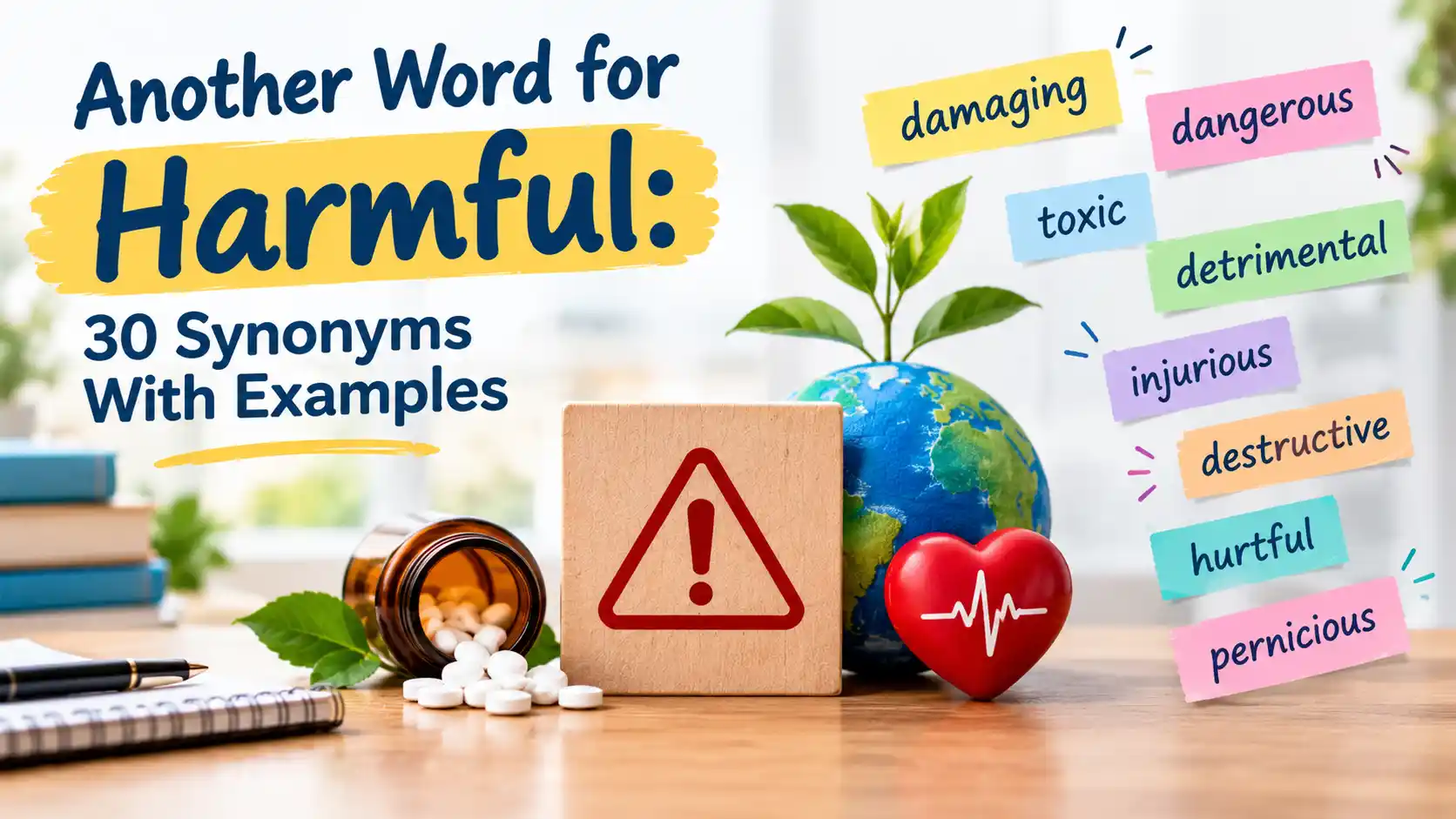
The closest everyday alternatives to “harmful” are damaging, dangerous, and bad (as in “bad for you”). In formal writing, detrimental, injurious, and deleterious are common choices. The best word depends on what is being harmed and how strongly: a body, the environment, feelings, a plan, or a whole society.
“Harmful” covers health, physical danger, poison, emotional pain, and slow or hidden damage. A word such as “toxic” fits chemicals and unhealthy relationships, “hurtful” fits unkind words, and “counterproductive” fits plans that backfire.
Quick list: damaging, detrimental, dangerous, toxic, hazardous, injurious, destructive, pernicious, hurtful, unhealthy
This article looks at 30 alternatives. Each has a meaning, IPA, usage note, and example, followed by sections on context, word pairs, collocations, expressions, and word history.
At a Glance: Harmful Synonyms and Related Alternatives
| Alternative | Part of Speech | Meaning | Register / Tone | Ideal Context |
| Damaging | adjective | causing harm or loss | Neutral | Health, reputation, property |
| Dangerous | adjective | likely to cause harm or injury | Everyday | Risk of injury or death |
| Detrimental | adjective | causing harm or disadvantage | Formal | Effects on health, progress, results |
| Injurious | adjective | causing injury or damage | Formal | Legal, medical, technical writing |
| Unhealthy | adjective | bad for health | Everyday | Food, habits, air, conditions |
| Toxic | adjective | poisonous, or very damaging | Neutral, figurative | Chemicals, workplaces, relationships |
| Hazardous | adjective | involving danger or risk | Formal to neutral | Materials, waste, conditions |
| Destructive | adjective | causing great damage | Neutral | Storms, habits, behavior |
| Pernicious | adjective | harmful in a gradual or hidden way | Formal | Influence, ideas, habits |
| Hurtful | adjective | causing emotional pain | Everyday | Words, remarks, behavior |
Which Word Should You Use?
| If you want to… | Use | Why |
| Say it simply | bad for / damaging | Both are clear in everyday speech |
| Write formally or academically | detrimental / deleterious | They suit reports and research |
| Describe poisons and chemicals | toxic / poisonous | They name the cause of harm |
| Warn about risk of injury | dangerous / hazardous | They stress the chance of serious harm |
| Describe unkind words | hurtful | It points to emotional pain |
| Describe slow, hidden damage | corrosive / pernicious | They suggest harm that builds over time |
| Describe something that can kill | deadly | It is stronger than “harmful” |
| Describe a plan that backfires | counterproductive | It shows the result is the opposite of the aim |
Exploring the Multiple Meanings of “Harmful”

1. Damaging to Health or the Body
- Meaning: Causing physical injury or illness, or likely to.
- Explanation: This is the most common sense. It covers chemicals, foods, habits, and noise. Words like “unhealthy,” “toxic,” and “injurious” fit here.
- Example: Loud music can be harmful to your hearing.
2. Damaging to the Environment or Things
- Meaning: Causing damage to nature, property, or systems.
- Explanation: Here the harm falls on something other than a person: air, water, animals, or equipment. “Damaging,” “destructive,” and “hazardous” are close alternatives.
- Example: Some cleaning products are harmful to the environment.
3. Hurtful to Feelings or the Mind
- Meaning: Causing emotional or mental damage.
- Explanation: “Harmful” can describe words, behavior, and relationships. It is broader than “hurtful,” which focuses on feelings.
- Example: Constant criticism can be harmful to a child’s confidence.
4. Damaging to Society, Rules, or Results
- Meaning: Having a bad effect on a group, a system, or an outcome.
- Explanation: This sense is used for ideas, policies, online content, and behavior that weakens something larger. It is often more abstract than the physical senses.
- Example: The site removed content it judged harmful to young users.
Analyzing 30 Harmful Alternatives in Detail
Some of these alternatives are direct synonyms of “harmful,” while others are related words that fit only certain contexts, as noted in each usage note.
Everyday Alternatives
1. Bad
IPA: /bæd/ (US and UK)
Definition: Not good, or causing harm when used with “for.”
- Usage: A simple, informal alternative, mostly in the pattern “bad for.” It is less precise and less strong than “harmful.”
- Example: Too much sugar is bad for your teeth.
2. Damaging
IPA: /ˈdæmɪdʒɪŋ/ (US and UK)
Definition: Causing harm, injury, or loss.
- Usage: A close, neutral synonym. It works for health, reputation, property, and relationships.
- Example: The rumor was damaging to her reputation.
3. Unhealthy
IPA: /ʌnˈhɛlθi/ (US and UK)
Definition: Bad for health, or showing poor health.
- Usage: A related alternative for health only. It does not describe damage to feelings or society.
- Example: Eating only fried food is an unhealthy habit.
4. Dangerous
IPA: /ˈdeɪndʒərəs/ (US and UK)
Definition: Able or likely to cause harm, injury, or death.
- Usage: A close synonym that is stronger on risk. “Dangerous” often suggests an immediate threat, while “harmful” can describe slower damage.
- Example: The icy road is dangerous for drivers.
5. Unsafe
IPA: /ʌnˈseɪf/ (US and UK)
Definition: Not safe, or likely to cause harm.
- Usage: A related alternative for places, food, water, and conditions. It is milder than “dangerous.”
- Example: The water was unsafe to drink.
Formal Alternatives
6. Detrimental
IPA: US /ˌdɛtrəˈmɛntəl/ · UK /ˌdɛtrɪˈmɛntəl/
Definition: Causing harm or damage.
- Usage: A close, formal synonym. It is usually followed by “to” and suits health, progress, and results.
- Example: Lack of sleep is detrimental to learning.
7. Injurious
IPA: US /ɪnˈdʒʊriəs/ · UK /ɪnˈdʒʊəriəs/
Definition: Causing or likely to cause injury or damage.
- Usage: A close, formal synonym. It appears in legal, medical, and technical writing.
- Example: The chemical is injurious to the skin.
8. Deleterious
IPA: US /ˌdɛləˈtɪriəs/ · UK /ˌdɛlɪˈtɪəriəs/
Definition: Harmful, often in a way that is not obvious.
- Usage: A formal, scientific synonym. It is rare in everyday speech.
- Example: The study found deleterious effects on soil health.
9. Adverse
IPA: US /ædˈvɜrs/ · UK /ˈædvɜːs/
Definition: Harmful or unfavorable.
- Usage: A related, formal alternative. It often goes with “effects,” “reaction,” and “weather,” and it can mean “unfavorable” without strong harm.
- Example: Some patients had adverse reactions to the drug.
10. Inimical
IPA: /ɪˈnɪmɪkəl/ (US and UK)
Definition: Harmful or hostile to something.
- Usage: A formal, rare, related alternative. It is followed by “to” and used for ideas or conditions that work against something.
- Example: Strict rules can be inimical to creativity.
Poison, Pollution, and Health Risks
11. Toxic
IPA: US /ˈtɑksɪk/ · UK /ˈtɒksɪk/
Definition: Poisonous, or very harmful in a figurative sense.
- Usage: A related alternative. It suits chemicals and also unhealthy workplaces or relationships.
- Example: The factory dumped toxic waste into the river.
12. Poisonous
IPA: /ˈpɔɪzənəs/ (US and UK)
Definition: Containing poison or able to harm or kill by poison.
- Usage: A related alternative that is mostly literal. It suits plants, substances, and fumes.
- Example: Some wild berries are poisonous.
13. Noxious
IPA: US /ˈnɑkʃəs/ · UK /ˈnɒkʃəs/
Definition: Harmful to health, especially of gases or substances.
- Usage: A formal, related alternative. It is most common with fumes, gases, and weeds.
- Example: Noxious fumes filled the room.
14. Hazardous
IPA: US /ˈhæzərdəs/ · UK /ˈhæzədəs/
Definition: Involving danger or risk.
- Usage: A related alternative for materials, waste, and conditions. It is common in safety rules.
- Example: The company stores hazardous materials in a locked room.
15. Deadly
IPA: /ˈdɛdli/ (US and UK)
Definition: Likely to cause death.
- Usage: A related alternative that is much stronger than “harmful.” It should be used only when death is a real risk.
- Example: The virus can be deadly for older adults.
Strong or Severe Harm
16. Destructive
IPA: /dɪˈstrʌktɪv/ (US and UK)
Definition: Causing great damage or destroying things.
- Usage: A related alternative that is stronger than “harmful.” It fits storms, habits, and behavior.
- Example: The storm was one of the most destructive in years.
17. Ruinous
IPA: /ˈruːɪnəs/ (US and UK)
Definition: Causing ruin or disaster.
- Usage: A related, formal alternative. It is mostly used for money, policies, and decisions.
- Example: The high interest rate was ruinous for small businesses.
18. Devastating
IPA: US /ˈdɛvəˌsteɪtɪŋ/ · UK /ˈdɛvəsteɪtɪŋ/
Definition: Causing severe damage or shock.
- Usage: A related alternative that is stronger than “harmful.” It also describes shocking news, not just damage.
- Example: The drought had a devastating effect on farmers.
19. Pernicious
IPA: US /pərˈnɪʃəs/ · UK /pəˈnɪʃəs/
Definition: Harmful in a gradual or hidden way.
- Usage: A formal, close alternative for slow damage. It is often used for ideas, influences, and habits.
- Example: Fear can be a pernicious influence on a team.
20. Malignant
IPA: /məˈlɪɡnənt/ (US and UK)
Definition: Having a very harmful influence, or (in medicine) cancerous.
- Usage: A formal, related alternative. In everyday use it describes an evil or very harmful influence. The medical sense, “cancerous,” is different.
- Example: The rumor had a malignant effect on the company.
Harm to People, Trust, and Spirit
21. Hurtful
IPA: US /ˈhɜrtfəl/ · UK /ˈhɜːtfəl/
Definition: Causing emotional pain.
- Usage: A related alternative. It fits words, remarks, and behavior, and it is narrower than “harmful.”
- Example: Her hurtful comment made him leave the room.
22. Abusive
IPA: /əˈbjuːsɪv/ (US and UK)
Definition: Harmful through mistreatment or insulting language.
- Usage: A related alternative for behavior toward people. It is strong and should be used only when mistreatment is meant.
- Example: The coach was removed for abusive language.
23. Corrosive
IPA: US /kəˈroʊsɪv/ · UK /kəˈrəʊsɪv/
Definition: Gradually destroying something, either literally or figuratively.
- Usage: A related alternative. It suits chemicals and also slow damage, as in “corrosive effect on trust.”
- Example: Constant gossip had a corrosive effect on the team.
24. Unwholesome
IPA: US /ʌnˈhoʊlsəm/ · UK /ʌnˈhəʊlsəm/
Definition: Harmful to health or to good character.
- Usage: A related, somewhat old-fashioned alternative. It suits food, habits, and influences.
- Example: He warned them against unwholesome habits.
25. Demoralizing
IPA: US /dɪˈmɔrəˌlaɪzɪŋ/ · UK /dɪˈmɒrəlaɪzɪŋ/
Definition: Causing a loss of confidence or hope.
- Usage: A related alternative for harm to spirit and motivation. It does not describe physical harm.
- Example: Repeated failure was demoralizing for the whole team.
Risk and Backfiring Effects
26. Risky
IPA: /ˈrɪski/ (US and UK)
Definition: Involving a chance of harm or loss.
- Usage: A related alternative. It suggests possible harm, not certain harm.
- Example: Driving in heavy fog is risky.
27. Prejudicial
IPA: US /ˌprɛdʒəˈdɪʃəl/ · UK /ˌprɛdʒʊˈdɪʃəl/
Definition: Harmful to someone’s rights, case, or interests.
- Usage: A formal, context-specific alternative, especially in law. Do not confuse it with “prejudiced,” which describes a person with unfair opinions.
- Example: The judge ruled that the evidence was prejudicial.
28. Counterproductive
IPA: US /ˌkaʊntərprəˈdʌktɪv/ · UK /ˌkaʊntəprəˈdʌktɪv/
Definition: Having the opposite effect from the one intended.
- Usage: A related alternative for plans and methods that backfire. It does not mean physically harmful.
- Example: Shouting at the team was counterproductive.
29. Self-destructive
IPA: /ˌsɛlf dɪˈstrʌktɪv/ (US and UK)
Definition: Harmful to oneself.
- Usage: A related alternative for behavior that damages the person doing it.
- Example: He later regretted his self-destructive habits.
30. Disadvantageous
IPA: /ˌdɪsædvænˈteɪdʒəs/ (US and UK)
Definition: Creating a disadvantage or unfavorable position.
- Usage: A formal, related alternative. It is milder than “harmful” and focuses on a weaker position, not injury.
- Example: The new rule is disadvantageous to smaller companies.
Harmful vs. Dangerous vs. Toxic vs. Detrimental

These four words overlap, but each has a different focus.
| Word | Main Focus | Typical Use | Example |
| Harmful | causing or likely to cause harm, in general | Health, environment, feelings | Smoke is harmful to the lungs. |
| Dangerous | risk of serious harm or injury | Roads, animals, activities | The cliff is dangerous. |
| Toxic | poison, or very bad influence | Chemicals, workplaces | Toxic waste was found. |
| Detrimental | harm to a result or condition | Formal writing | Stress is detrimental to health. |
“Harmful” is the broadest word of the four. “Dangerous” often suggests a risk of serious harm, and “toxic” points to poison or a very damaging environment. “Detrimental” is the formal choice for harm to progress, health, or results.
Harmful and Opposite/Paired Word Pairs
| Word | Paired Word | Note |
| Harmful | Harmless | The direct opposite, formed from the same root |
| Harmful | Beneficial | The standard opposite in formal writing |
| Harmful | Helpful | A simple, everyday contrast |
| Harmful | Safe | Used for foods, products, and places |
| Harmful | Wholesome | Used for food, habits, and influences |
| Toxic | Nontoxic | A common pair for products and materials |
| Hazardous | Safe | A common pair in safety contexts |
| Harm | Benefit | The noun pair |
“Harmless” is the closest opposite and comes from the same base word. Etymonline dates “harmless” to about 1300, first with the meaning “uninjured,” and later, from the 1530s, with the meaning “without power or disposition to harm.” In formal writing, “beneficial” is the usual contrast.
Common Word Partners of “Harmful”
| Pattern | Common Partners | Example |
| harmful to + noun | health, the environment, children, others | Smoke is harmful to health. |
| harmful + noun | effects, chemicals, substances, bacteria, habits, content | Some bacteria are harmful. |
| adverb + harmful | potentially, highly, seriously, extremely | These chemicals are potentially harmful. |
| verb + harmful | is, prove, found, considered, deemed | The ingredient was found to be harmful. |
| harmful + noun (digital) | content, software, behavior | The app blocks harmful content. |
| harmful + noun (nature) | algae, species, pollutants | Harmful algae can poison fish. |
Idiomatic Phrases Featuring “Harmful”
“Harmful” itself appears in very few fixed phrases, so these are established expressions built on the base word “harm, plus one expression that uses “harmful” directly.
1. Considered harmful
- Meaning: A phrase used in titles and arguments to say that something should be avoided. It became well known through a 1968 computing article, and writers still copy the pattern.
- Example: The article was titled “Long Meetings Considered Harmful.”
2. In harm’s way
- Meaning: In a place or situation where harm is possible. Etymonline dates the phrase to the 1660s.
- Example: The rescue team put themselves in harm’s way to save the hikers.
3. Do more harm than good
- Meaning: To cause more damage than benefit.
- Example: Giving advice without knowing the facts can do more harm than good.
4. Mean no harm
- Meaning: To have no bad intention, even if something goes wrong.
- Example: He meant no harm when he joked about her hat.
Word Formation of “Harmful”

Etymology & Structure
“Harmful” is made of the noun harm and the suffix -ful. Etymonline traces harm to Old English hearm, meaning “hurt, pain; evil, grief; insult,” from a Proto-Germanic form, and links it to a Proto-Indo-European root meaning “pain.” The suffix -ful comes from the word full. Etymonline explains that many -ful adjectives could be “full of” something or “causing” something. “Harmful” uses the second meaning: it causes harm.
Date and History
Dictionary.com records the word as first used before 1000, from Old English hearmful. Etymonline notes that Old English had hearmful, but says the modern word is probably a Middle English formation, dated to the mid-14th century. Etymonline also gives Old English hemeran, “to hurt, injure,” as the origin of the verb harm.
Word Class Variations
- Adjective: harmful; harmless (c. 1300)
- Adverb: harmfully; harmlessly
- Noun: harm; harmfulness; harmlessness
- Verb: harm, harms, harmed, harming
- Related words: hurtful (mid-15th century, “harmful, injurious”); unharmed
Common Word-Choice Mistakes
- “Smoking is harmful for health”: “Smoking is harmful to health.”
- “The chemical is harmful”: “The chemical is harmful.”
- “His words were very harmful”: “His words were very harmful.”
- “Smoking is harmless to your lungs” (meaning it is bad): “Smoking is harmful to your lungs.”
- “The cobra is poisonous”: “The cobra is venomous.” (Venomous animals inject poison with a bite or sting.)
- “Dangerous words hurt her feelings”: “Hurtful words hurt her feelings.”
- “Too much screen time is deadly for children”: “Too much screen time is harmful to children.” (“Deadly” overstates the risk.)
Frequently Asked Questions
What is the closest synonym for “harmful”?
“Damaging” and “detrimental” are the closest. “Bad for” is the simplest everyday choice.
What is a formal alternative to “harmful”?
“Detrimental,” “injurious,” and “deleterious” are formal. “Adverse” is common in medical and technical writing.
What is the difference between “harmful” and “dangerous”?
“Dangerous” stresses the risk of serious harm, often right away. “Harmful” describes a bad effect, which can be slow or small.
What is the difference between “harmful” and “toxic”?
“Toxic” means poisonous, or very damaging in a figurative way, as in a toxic workplace. “Harmful” is broader and includes things that are not poisons.
What is the opposite of “harmful”?
“Harmless” is the direct opposite. “Beneficial” and “helpful” also work, depending on the sentence.
Which preposition goes with “harmful”?
“Harmful to” is the standard pattern, as in “harmful to health.” “Harmful for” also appears in some dictionary examples.
Can “harmful” describe people?
It is mostly used for things, effects, and behavior, such as harmful habits. For people, “dangerous” or “toxic” is more common.
What word describes unkind words?
“Hurtful” is the best fit. “Harmful” also works when the damage is serious, such as to a child’s confidence.
What does “considered harmful” mean?
It is an expression used to say that something should be avoided or given up. It is used in titles, especially in technology writing.
Is “harmful” a strong word?
It is a general word, and its strength depends on the sentence. For stronger harm, “destructive,” “devastating,” and “deadly” are available.
Conclusion
The closest and most common alternatives to “harmful” are “damaging,” “detrimental,” “dangerous,” and “bad for.” In formal writing, “injurious” and “deleterious” are also available.
Context matters because the words differ in what they describe and how strongly. “Toxic” and “poisonous” point to poison, “hurtful” points to feelings, “pernicious” points to hidden damage, and “deadly” points to death.
To choose the right word, first decide what is being harmed and how seriously. Then match the tone, from everyday to formal, and check the preposition: most of these words take “to,” as in “harmful to health.”
Sources: Dictionary.com; Etymonline; Merriam-Webster; Collins Dictionary

Haleema Sadia is an experienced content writer with three years of expertise in English vocabulary, synonyms, and word meanings. At TrueVisite, she creates clear, accurate, and reader-friendly content that helps people expand their vocabulary, understand word usage, and communicate with greater confidence. Her goal is to make learning English simple, practical, and accessible to everyone.