The closest everyday alternatives to “throughout” are “during” and “all through,” though the best choice depends on whether you mean time, space, or both. “Throughout” is unusual among prepositions because it covers two distinct ideas at once: continuing across an entire period of time, or extending across an entire physical space.
Because “throughout” works as both a time-based and a space-based word, many of its synonyms only cover one of these two senses, not both. A word like “during” fits time but not space, while “across” fits space but not time. Picking the right alternative means first deciding whether you’re describing duration, extent, or both.
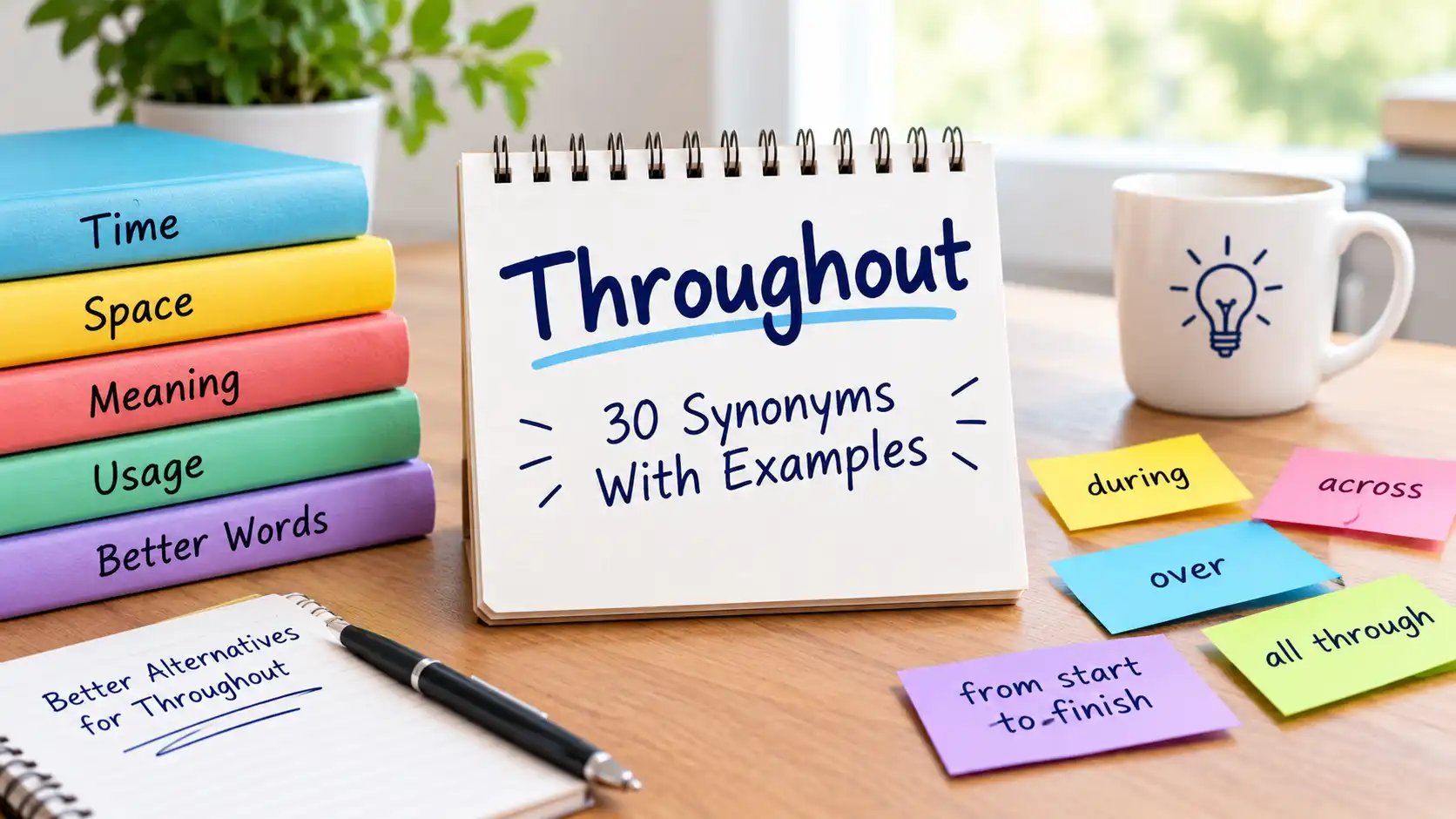
Quick list: during, all through, across, over, in every part of, from start to finish, all over, at every point, the whole time, from beginning to end
This article examines 30 alternatives to “throughout,” with meanings, pronunciation, usage notes, and example sentences, so you can choose the word that fits your exact context.
At a Glance: Throughout Synonyms and Related Alternatives
| Alternative | Part of Speech | Meaning | Register / Tone | Ideal Context |
| during | preposition | For the entire time of; at some point within | Neutral | Time-based events |
| all through | preposition phrase | For the whole duration of | Neutral/informal | Time, especially emphasis |
| across | preposition | Extending from one side to another | Neutral | Space, geography |
| over | preposition | Extending across or during | Neutral | Time or space, general |
| all over | preposition phrase | In every part of a place | Informal/neutral | Physical space |
| from start to finish | phrase | For the entire duration | Neutral | Time, emphasis on completeness |
| in every part of | phrase | In all sections or areas of | Formal/neutral | Space, organizations |
| the whole time | phrase | For the entire duration | Informal | Casual time references |
| from beginning to end | phrase | Covering the entire duration or sequence | Neutral/formal | Time, narratives |
| pervading | adjective/participle | Spreading through every part | Formal/literary | Figurative, atmosphere |
Which Word Should You Use?

| If you want to… | Use | Why |
| Describe something happening across a whole time period | during, all through, the whole time | These focus specifically on duration, not physical space |
| Describe something spread across a physical area | across, all over, in every part of | These focus on space, not time |
| Sound more formal or precise | throughout the duration of, over the course of | These suit reports, essays, and professional writing |
| Emphasize completeness from start to end | from start to finish, from beginning to end | These stress the full span, often used in narratives or processes |
| Describe a feeling or quality spread across something | pervading, permeating | These work for abstract or figurative spread, like mood or theme |
| Keep a casual, conversational tone | all through, the whole time, all over | These fit everyday speech better than formal alternatives |
| Describe consistency across many instances | consistently, uniformly | These emphasize sameness across time or space, not just presence |
Exploring the Multiple Meanings of “Throughout”
1. For the Entire Duration (Time)
- Meaning: Continuing for the whole length of a period of time.
- Explanation: This sense describes something that happens continuously or repeatedly across an entire timeframe, not just at one point.
- Example: “She remained calm throughout the interview.”
2. In Every Part (Space)
- Meaning: Present in or affecting all parts of a physical area.
- Explanation: This sense describes something spread across an entire location, building, or region, rather than a single spot.
- Example: “The smell of fresh bread spread throughout the house.”
3. In Every Part (Figurative or Abstract)
- Meaning: Present in all parts of something non-physical, like a document, idea, or organization.
- Explanation: This extends the spatial sense to abstract structures, such as a book, a company, or a set of beliefs.
- Example: “The theme of loss appears throughout the novel.”
Sources: Merriam-Webster, Etymonline
Analyzing 30 Throughout Alternatives in Detail
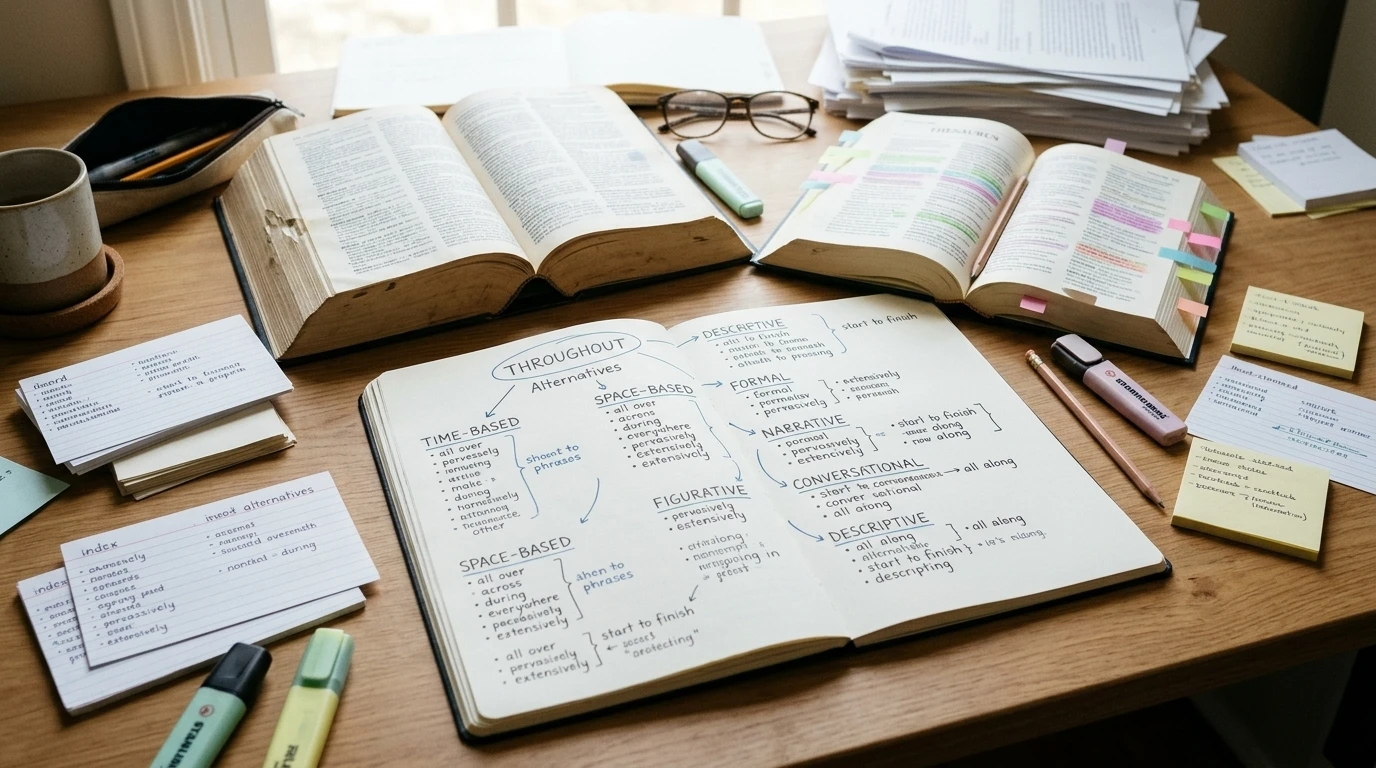
Some of these alternatives are direct synonyms for one sense of “throughout,” while others are context-specific related words that only work in certain situations. Each entry notes which applies.
Time-Based Alternatives
1. During
IPA: US /ˈdʊrɪŋ/ · UK /ˈdjʊərɪŋ/
Definition: Throughout the course of; at some point within a period of time.
- Usage: A close synonym for the time-based sense of “throughout,” though “during” can also mean “at some point within,” while “throughout” always implies the full duration.
- Example: “He took notes during the entire lecture.”
2. All through
IPA: (US and UK) /ɔːl θruː/
Definition: For the complete duration of a period.
- Usage: A close, slightly more informal synonym for the time-based sense of “throughout.”
- Example: “The baby cried all through the night.”
3. The whole time
IPA: (US and UK) /ðə hoʊl taɪm/
Definition: For the entire duration without interruption.
- Usage: An informal, conversational alternative, best suited to casual speech rather than formal writing.
- Example: “She was nervous the whole time she waited for the results.”
4. Over the course of
IPA: (US and UK) /ˈoʊvər ðə kɔːrs ʌv/
Definition: During the entire period in which something happens or develops.
- Usage: A more formal alternative, often used when describing gradual change across time.
- Example: “The company grew steadily over the course of ten years.”
5. From start to finish
IPA: (US and UK) /frʌm stɑːrt tə ˈfɪnɪʃ/
Definition: From the very beginning to the very end.
- Usage: Emphasizes completeness across time, often used for events or processes rather than physical spaces.
- Example: “The event ran smoothly from start to finish.”
6. From beginning to end
IPA: (US and UK) /frʌm bɪˈɡɪnɪŋ tə ɛnd/
Definition: Covering the entire duration or sequence of something.
- Usage: Very close in meaning to “from start to finish,” slightly more common in narrative or written contexts.
- Example: “The documentary held my attention from beginning to end.”
7. Continuously
IPA: US /kənˈtɪnjuəsli/ · UK /kənˈtɪnjuəsli/
Definition: Without interruption or break.
- Usage: A related alternative focused on the unbroken nature of an action, rather than simply its presence across a time period.
- Example: “The machine ran continuously throughout the shift.”
Space-Based Alternatives
8. Across
IPA: US /əˈkrɔːs/ · UK /əˈkrɒs/
Definition: From one side of something to the other; over the whole area of.
- Usage: A close synonym for the spatial sense of “throughout,” though “across” more often implies movement or span rather than presence everywhere.
- Example: “The signal reaches homes across the entire city.”
9. All over
IPA: (US and UK) /ɔːl ˈoʊvər/
Definition: In or to every part of a place.
- Usage: An informal, direct synonym for the spatial sense of “throughout.”
- Example: “Dust had settled all over the furniture.”
10. In every part of
IPA: (US and UK) /ɪn ˈɛvri pɑːrt ʌv/
Definition: In all sections or areas of a place or structure.
- Usage: A more formal, explicit synonym, often used in technical or official writing.
- Example: “New safety signs were installed in every part of the facility.”
11. Throughout the entirety of
IPA: (US and UK) /θruːˈaʊt ði ɪnˈtaɪərəti ʌv/
Definition: Covering the complete extent of something.
- Usage: A more formal, emphatic phrase, often slightly redundant in casual writing but useful for formal documents needing precision.
- Example: “Security was present throughout the entirety of the building.”
12. Spanning
IPA: (US and UK) /ˈspænɪŋ/
Definition: Extending across or over a particular area or period.
- Usage: A related alternative, often used for both time and space, especially in descriptive or formal writing.
- Example: “The exhibit features artwork spanning several centuries.”
Figurative and Abstract Alternatives
13. Pervading
IPA: (US and UK) /pərˈveɪdɪŋ/
Definition: Spreading through and becoming noticeable in every part of something.
- Usage: A formal, literary alternative, best for describing moods, themes, or qualities rather than physical objects.
- Example: “A sense of unease was pervading the entire meeting.”
14. Permeating
IPA: (US and UK) /ˈpɜːrmieɪtɪŋ/
Definition: Spreading throughout something, especially gradually.
- Usage: Similar to “pervading,” often used for smells, feelings, or influences spreading through a space or group.
- Example: “The scent of cinnamon was permeating the kitchen.”
15. Suffused
IPA: (US and UK) /səˈfjuːzd/
Definition: Gradually spread through or over something, especially light, color, or emotion.
- Usage: A literary, figurative alternative, limited mostly to descriptions of light, color, or emotional tone.
- Example: “The room was suffused with a warm golden light.”
Formal and Precise Alternatives
16. In every respect
IPA: (US and UK) /ɪn ˈɛvri rɪˈspɛkt/
Definition: In all aspects or ways.
- Usage: A related alternative, used for abstract qualities or consistency rather than physical presence across time or space.
- Example: “The report was thorough in every respect.”
17. Uniformly
IPA: (US and UK) /ˈjuːnɪfɔːrmli/
Definition: In the same way or to the same degree everywhere.
- Usage: A related alternative emphasizing consistency, not simply presence throughout.
- Example: “The paint was applied uniformly across the surface.”
18. Consistently
IPA: (US and UK) /kənˈsɪstəntli/
Definition: In a way that stays the same over time.
- Usage: A related alternative focused on steadiness rather than full coverage of time or space.
- Example: “Sales remained consistently strong throughout the year.”
19. Over the whole of
IPA: (US and UK) /ˈoʊvər ðə hoʊl ʌv/
Definition: Covering the entire extent of something.
- Usage: A formal, slightly old-fashioned phrase, interchangeable with “throughout” in both time and space contexts.
- Example: “Rain is expected over the whole of the region tomorrow.”
Narrative and Process-Based Alternatives
20. At every stage of
IPA: (US and UK) /æt ˈɛvri steɪdʒ ʌv/
Definition: At each step or phase of a process.
- Usage: A related alternative, best for describing processes or sequences rather than fixed time periods.
- Example: “The team offered support at every stage of the project.”
21. At every point in
IPA: (US and UK) /æt ˈɛvri pɔɪnt ɪn/
Definition: At each moment or location within something.
- Usage: A flexible alternative that can apply to either time or space, depending on context.
- Example: “The guide was helpful at every point in the tour.”
22. All the way through
IPA: (US and UK) /ɔːl ðə weɪ θruː/
Definition: From the beginning to the end, without stopping.
- Usage: An informal alternative, close to “throughout,” often used for stories, journeys, or processes.
- Example: “He stayed focused all the way through the exam.”
Everyday and Conversational Alternatives
23. The entire time
IPA: (US and UK) /ði ɪnˈtaɪər taɪm/
Definition: For all of the duration, without exception.
- Usage: An everyday alternative, very close to “the whole time,” common in casual speech.
- Example: “She smiled the entire time during the photo shoot.”
24. Nonstop
IPA: (US and UK) /ˌnɒnˈstɒp/
Definition: Without any pause or interruption.
- Usage: A related, informal alternative, emphasizing continuity more than simple presence across a period.
- Example: “It rained nonstop throughout the entire weekend.”
25. Everywhere in
IPA: (US and UK) /ˈɛvriwɛər ɪn/
Definition: In all locations within a particular place.
- Usage: A close, informal synonym for the spatial sense of “throughout.”
- Example: “You can find bookshelves everywhere in her apartment.”
Descriptive and Structural Alternatives
26. In every corner of
IPA: (US and UK) /ɪn ˈɛvri ˈkɔːrnər ʌv/
Definition: In every part of a place, often implying thoroughness.
- Usage: A figurative, descriptive alternative, often used for emphasis in storytelling or persuasive writing.
- Example: “News of the discovery spread to every corner of the scientific community.”
27. Woven throughout
IPA: (US and UK) /ˈwoʊvən θruːˈaʊt/
Definition: Present as a consistent element running through something, often figuratively.
- Usage: A literary, figurative phrase, used mainly for themes, ideas, or patterns within writing or art.
- Example: “Humor is woven throughout the entire film.”
28. Found in every part of
IPA: (US and UK) /faʊnd ɪn ˈɛvri pɑːrt ʌv/
Definition: Present across all sections of something.
- Usage: A descriptive, slightly formal phrase, functionally similar to “throughout” in spatial contexts.
- Example: “References to the war can be found in every part of the museum’s exhibits.”
29. Omnipresent
IPA: US /ˌɒmniˈprɛzənt/ · UK /ˌɒmnɪˈprɛzənt/
Definition: Present everywhere at the same time.
- Usage: A formal, sometimes dramatic alternative, best for emphasizing something’s complete and constant presence.
- Example: “Technology has become almost omnipresent in modern classrooms.”
30. Running through
IPA: (US and UK) /ˈrʌnɪŋ θruː/
Definition: Present as a continuous element within something, often figuratively.
- Usage: A figurative alternative, close in meaning to “woven throughout,” often used for themes or qualities.
- Example: “A quiet sadness runs through the entire poem.”
Sources: Merriam-Webster, Collins Dictionary, Dictionary.com
Throughout vs. During vs. Across
These three words are often confused because they all relate to extent, but they measure different things.
| Word | What It Measures | Example |
| Throughout | Full duration of time, or complete coverage of space | “She worked hard throughout the semester.” |
| During | A period within which something happens, not necessarily the full length | “She called during the meeting.” |
| Across | Movement or span from one side to another, usually spatial | “The bridge stretches across the river.” |
Throughout and Opposite/Paired Word Pairs
| Word | Paired Word | Note |
| throughout | nowhere | Contrasts complete spatial presence with complete absence |
| throughout | briefly | Contrasts full duration with a short period of time |
| consistent | sporadic | Natural contrast between steady presence and occasional presence |
| entire | partial | Contrasts complete coverage with incomplete coverage |
Common Word Partners of “Throughout”
| Pattern | Common Partners | Example |
| throughout + time period | throughout the day, throughout the year, throughout history | “Temperatures stayed mild throughout the day.” |
| throughout + place | throughout the country, throughout the building, throughout the world | “The policy applies throughout the country.” |
| throughout + process | throughout the process, throughout the project | “Communication remained clear throughout the process.” |
| adjective + throughout | consistent throughout, present throughout | “The quality remained consistent throughout.” |
Idiomatic Phrases Featuring “Throughout”

1. Through and through
- Meaning: Completely or thoroughly, in every respect.
- Example: “He’s a professional through and through.”
2. From start to finish
- Meaning: Covering an entire event or process without leaving anything out.
- Example: “The chef prepared the meal from start to finish in under an hour.”
3. Day in, day out
- Meaning: Happening every day, continuously, without variation.
- Example: “She practices the piano day in, day out.”
Sources: Merriam-Webster, Collins Dictionary
Word Formation of “Throughout”

Etymology & Structure
“Throughout” formed by combining “through” and “out.” The word traces back to late Old English þurhut, meaning “completely through, in at one end and out another,” a sense now archaic. “Through” itself comes from Old English þurh, from Proto-Germanic thurx, ultimately from the Proto-Indo-European root tere-, meaning “to cross over, pass through, overcome.” “Out” comes from Old English ut, from Proto-Germanic ūt-.
Date and History
The combined form appeared in Middle English as thurgh-out. By around 1200, it was used to mean “during (a specified time).” By around 1300, it had developed the sense “all over within,” referring to space. As an adverb, “throughout” dates back to the 12th century, meaning “in all respects, everywhere, in every part.”
Word Class Variations
- Preposition: throughout (as in “throughout the day”)
- Adverb: throughout (as in “the building was painted white throughout”)
Unlike many English words, “throughout” does not have separate noun, verb, or adjective forms; it functions only as a preposition and adverb.
Sources: Etymonline, Merriam-Webster
Common Word-Choice Mistakes
- “Throughout the meeting, during ten minutes” → correct: “During the meeting, for ten minutes,” since “throughout” does not combine naturally with a specific short duration.
- Using “across” for time → correct: use “throughout” or “during” for time; reserve “across” mainly for physical space.
- “The theme runs across the book” when meaning a consistent element → correct: “The theme runs throughout the book” better captures the idea of full coverage.
- Confusing “during” and “throughout” as fully interchangeable → correct: “during” can mean “at some point within,” while “throughout” implies the entire duration.
- “All over the meeting” to mean the full duration → correct: “all over” is spatial; use “all through” or “throughout” for time.
- Overusing “omnipresent” in casual writing → correct: reserve “omnipresent” for more formal or dramatic contexts, not everyday descriptions.
- “Pervading the whole day” in casual speech → correct: “pervading” fits figurative, often literary writing better than everyday time references.
Frequently Asked Questions
What is the closest synonym for “throughout”?
“During” is the closest synonym for the time-based sense, while “across” or “all over” are closest for the spatial sense, depending on context.
What is a formal alternative to “throughout”?
“Over the course of,” “in every part of,” and “throughout the entirety of” are strong formal choices for professional or academic writing.
What is the difference between “throughout” and “during”?
“Throughout” implies something happens for the entire duration, while “during” can simply mean at some point within a period, without lasting the whole time.
Can “throughout” be used for both time and space?
Yes. “Throughout” is one of the few words that naturally applies to both a full period of time and a full physical or abstract space.
What is a figurative alternative to “throughout”?
“Pervading,” “permeating,” and “woven throughout” are common figurative alternatives, often used for themes, moods, or qualities.
What is the opposite of “throughout”?
There isn’t one single opposite, but “nowhere” contrasts its spatial sense, while “briefly” contrasts its time-based sense.
Is “across” the same as “throughout”?
Not exactly. “Across” usually implies movement or span from one side to another, while “throughout” implies complete coverage or presence in every part.
What is a casual way to say “throughout”?
“All through,” “the whole time,” and “all over” are common informal alternatives used in everyday speech.
Does “throughout” always mean the entire time or space?
Yes, in standard use. Unlike “during,” which can mean just at some point, “throughout” always implies full duration or full coverage.
Can “throughout” describe a quality running through a piece of writing?
Yes. In this figurative sense, “throughout” describes a theme, tone, or element present consistently across an entire piece, similar to “woven throughout” or “running through.”
Conclusion
“Throughout” is a flexible word that covers both time and space, making it useful for describing something that lasts an entire period or spreads across an entire area. Because of this dual function, the best alternative always depends on which sense you mean: “during” or “all through” for time, and “across” or “all over” for space.
Context shapes word choice here more than tone alone. A word like “pervading” adds a literary, figurative quality that plain “throughout” lacks, while “the whole time” fits casual speech far better than formal alternatives like “over the course of.” Choosing well means identifying whether you’re describing duration, physical extent, or an abstract quality spreading through something.
When selecting a synonym for “throughout,” start by asking whether you mean time, space, or a figurative sense like theme or mood. From there, match the formality of your writing, whether casual, professional, or literary, to the right word from the list above. With these distinctions in mind, you can replace “throughout” with a word that fits your exact meaning and context.
Haleema Sadia is an experienced content writer with three years of expertise in English vocabulary, synonyms, and word meanings. At TrueVisite, she creates clear, accurate, and reader-friendly content that helps people expand their vocabulary, understand word usage, and communicate with greater confidence. Her goal is to make learning English simple, practical, and accessible to everyone.