
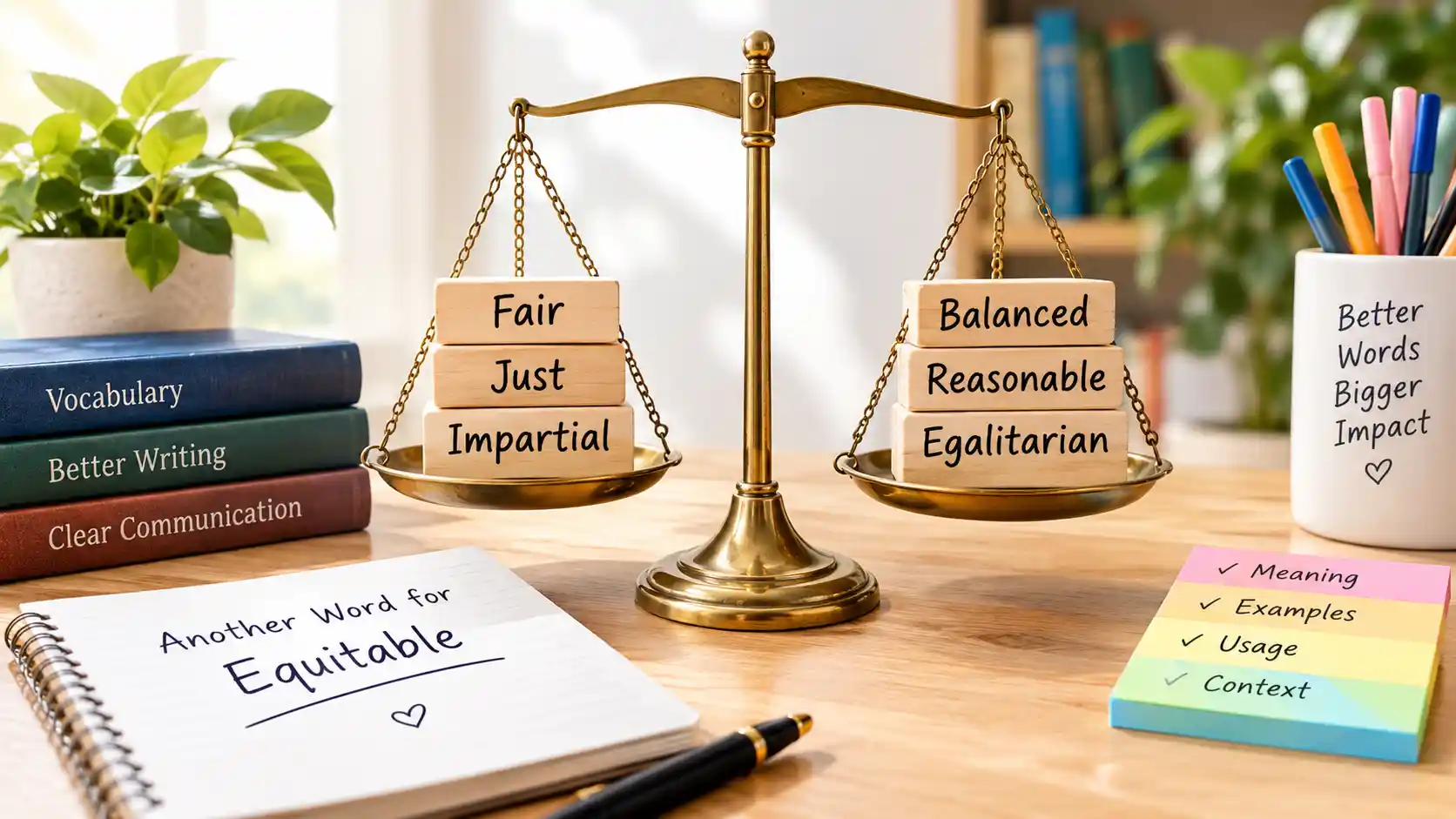
The closest plain choices for “equitable” are “fair” and “just.” Both words show people get the right treatment. In short, “impartial” also fits many cases.
The best choice depends on the meaning. You may mean equal shares, a moral act, or a neutral view. Also, you may mean a legal term.
Quick list: fair, just, even-handed, impartial, unbiased, balanced, reasonable, rightful, neutral, egalitarian
This article looks at 30 choices. Each one has a meaning, IPA, a usage note, and an example. You will also find context notes and word history.
At a Glance: Equitable Synonyms and Related Alternatives
| Alternative | Part of Speech | Meaning | Register / Tone | Ideal Context |
| Fair | adjective | right and equal in treatment | Everyday | Games, rules, pay |
| Just | adjective | right by law and morals | Formal to neutral | Courts, laws, causes |
| Even-handed | adjective | treating all sides the same | Neutral | Judges, leaders, news |
| Impartial | adjective | favoring no side | Formal | Judges, referees, reports |
| Unbiased | adjective | free from set opinions | Neutral | News, advice, studies |
| Balanced | adjective | giving each side fair weight | Neutral | Reports, plans |
| Reasonable | adjective | fair and sensible | Everyday | Prices, offers, demands |
| Rightful | adjective | owed by fair claim | Formal | Shares, owners, claims |
| Neutral | adjective | taking no side | Neutral | Talks, experts, judges |
| Egalitarian | adjective | based on equal rights for all | Formal | Groups, systems, ideas |
Which Word Should You Use?

| If you want to… | Use | Why |
| Say it in plain words | fair / just | Both are clear and common |
| Describe a judge or referee | impartial / even-handed | They show no side wins |
| Describe shares of money or time | equal / balanced / proportionate | They show fair sizes |
| Describe a price or demand | reasonable / justifiable | They show it is not too much |
| Describe a claim by right | rightful / legitimate | They show a fair claim |
| Describe a view without sides | neutral / objective / nonpartisan | They show no bias |
| Describe rules for all groups | egalitarian / inclusive / nondiscriminatory | They show equal rights |
| Describe moral conduct | ethical / principled / honorable | They show a strong moral tone |
Exploring the Multiple Meanings of “Equitable”

1. Fair and Just
- Meaning: Right and fair to everyone involved.
- Explanation: This is the main sense. Etymonline dates the word to the 1640s.
- Example: The council reached an equitable decision for all families.
2. Fair and Equal in Shares
- Meaning: Shared in a fair and equal way.
- Explanation: People use it for money, land, and tasks. For example, heirs may seek an equitable split.
- Example: The friends agreed on an equitable split of the costs.
3. Fair for Each Case
- Meaning: Fair when you look at each person’s needs.
- Explanation: Etymonline says it means right in view of all the facts of a case. In policy writing, it often differs from “equal.”
- Example: An equitable plan gives extra help to students who need it.
4. A Legal Term
- Meaning: Based on equity, as courts of equity apply it.
- Explanation: Etymonline links “equity” in law to fairness in settling conflicting interests. Phrases like “equitable relief” use this sense.
- Example: The court granted equitable relief to the small business.
Analyzing 30 Equitable Alternatives in Detail
Some choices are direct synonyms, while others only fit certain cases.
Everyday Choices
1. Fair
IPA: US /fɛr/ · UK /feə/
Definition: It means you treat people in a right and equal way. It also covers rules that feel honest.
- Usage: It is the closest everyday match. However, it is less formal than “equitable.”
- Example: The coach gave every player a fair turn on the field.
2. Just
IPA: /dʒʌst/ (US and UK)
Definition: It means you act in a right and lawful way. It also shows a high moral standard.
- Usage: It is a close match with a serious tone. For example, courts seek a just ruling.
- Example: The judge gave a just ruling after hearing both sides.
3. Even-handed
IPA: /ˌiːvən ˈhændɪd/ (US and UK)
Definition: It means you treat all sides in the same way. It also shows you take no side.
- Usage: It is a close match for leaders and judges. In fact, it often praises their conduct.
- Example: The teacher was even-handed when two students argued.
4. Impartial
IPA: US /ɪmˈpɑrʃəl/ · UK /ɪmˈpɑːʃəl/
Definition: It means you favor no side. It also shows you judge by facts.
- Usage: It is a close, formal match. However, it shows no bias, not equal shares.
- Example: An impartial referee ended the argument with a clear call.
5. Unbiased
IPA: /ʌnˈbaɪəst/ (US and UK)
Definition: It means your view is free from set opinions. It also shows you weigh the facts.
- Usage: It is a close match for news and advice. Still, it does not mean equal shares.
- Example: She gave unbiased advice about both job offers.
Equal Shares and Balance Choices
6. Equal
IPA: /ˈiːkwəl/ (US and UK)
Definition: It means the same in size, amount, or rights. It also can mean fairness to all.
- Usage: It is a related choice, but it is not the same. For example, equal shares may not meet different needs.
- Example: The two teams received equal time to present their ideas.
7. Even
IPA: /ˈiːvən/ (US and UK)
Definition: It means flat, smooth, or the same on both sides. It also can mean fair.
- Usage: It is a related, informal choice. For example, people say “an even split.”
- Example: The friends made an even split of the bill.
8. Balanced
IPA: /ˈbælənst/ (US and UK)
Definition: It means each side gets a fair weight. It also shows no side wins too much.
- Usage: It is a close match for reports and plans. In fact, it often praises fair news.
- Example: The report gave a balanced view of the new law.
9. Proportionate
IPA: US /prəˈpɔrʃənət/ · UK /prəˈpɔːʃənət/
Definition: It means the size matches the need or effort. It also shows a fair link between two things.
- Usage: It is a formal, related choice. However, it focuses on size, not on rights.
- Example: The fine was proportionate to the size of the harm.
10. Square
IPA: US /skwɛr/ · UK /skweə/
Definition: It means honest and fair in a deal. It also sounds plain and friendly.
- Usage: It is an informal, related choice. For example, people say “a square deal.”
- Example: He gave me a square deal on the used bike.
Moral and Principled Choices
11. Ethical
IPA: /ˈɛθɪkəl/ (US and UK)
Definition: It means right by moral rules. It also shows you what is good.
- Usage: It is a related choice for conduct. However, it is wider than fair sharing.
- Example: The company has an ethical plan for fair pay.
12. Principled
IPA: US /ˈprɪnsəpəld/ · UK /ˈprɪnsɪpəld/
Definition: It means you act by firm rules of right and wrong. It also shows you stay steady.
- Usage: It is a related choice for people. In fact, it praises strong character.
- Example: She made a principled choice and kept her word.
13. Honorable
IPA: US /ˈɑnərəbəl/ · UK /ˈɒnərəbəl/
Definition: It means you act with honor and honesty. It also earns respect.
- Usage: It is a related, formal choice. However, it describes people more than systems.
- Example: He took the honorable path and told the truth.
14. Righteous
IPA: /ˈraɪtʃəs/ (US and UK)
Definition: It means you act in a morally right way. It also can sound proud.
- Usage: It is a related choice with a strong tone. However, it can suggest harsh pride.
- Example: The crowd praised the righteous judge for his fair ruling.
15. Scrupulous
IPA: US /ˈskruːpjələs/ · UK /ˈskruːpjʊləs/
Definition: It means you take great care to be honest and fair. It also shows you how to watch small details.
- Usage: It is a related, formal choice. Still, it fits conduct, not shares.
- Example: The auditor was scrupulous in her fair review of the books.
Reasonable and Rightful Choices
16. Reasonable
IPA: /ˈriːzənəbəl/ (US and UK)
Definition: It means fair and sensible. It also shows the price or demand is not too much.
- Usage: It is a close match for prices and offers. For example, a seller names a reasonable fee.
- Example: The shop charged a reasonable price for the repair.
17. Justifiable
IPA: US /ˈdʒʌstəˌfaɪəbəl/ · UK /ˈdʒʌstɪfaɪəbəl/
Definition: It means you can give a good reason for it. It also shows it is fair to do.
- Usage: It is a related choice for choices and acts. However, it needs a clear reason.
- Example: The delay was justifiable because of the storm.
18. Legitimate
IPA: US /lɪˈdʒɪtəmət/ · UK /lɪˈdʒɪtɪmət/
Definition: It means lawful or fair by accepted rules. It also shows a claim is valid.
- Usage: It is a related choice for claims and needs. For example, a legitimate complaint deserves a fair reply.
- Example: She raised a legitimate concern about how funds were shared.
19. Rightful
IPA: /ˈraɪtfəl/ (US and UK)
Definition: It means you have a fair claim to it. It also shows it belongs to you by right.
- Usage: It is a close match for shares and claims. In fact, “rightful share” is common.
- Example: Each heir received a rightful share of the farm.
20. Deserved
IPA: US /dɪˈzɜrvd/ · UK /dɪˈzɜːvd/
Definition: It means you earned it by your acts or needs. It also shows a fair reward.
- Usage: It is a related choice for rewards. However, it does not cover fair rules.
- Example: The team earned a deserved win after a hard season.
Neutral and Objective Choices
21. Objective
IPA: /əbˈdʒɛktɪv/ (US and UK)
Definition: It means you judge by facts, not feelings. It also shows you stay calm.
- Usage: It is a related choice for reports and views. However, it is not about equal shares.
- Example: The judge gave an objective view of the facts.
22. Neutral
IPA: US /ˈnutrəl/ · UK /ˈnjuːtrəl/
Definition: It means you take no side. It also shows you stay out of a fight.
- Usage: It is a related choice for talks and judges. For example, a neutral party can help.
- Example: The town hired a neutral expert to settle the dispute.
23. Dispassionate
IPA: /dɪˈspæʃənət/ (US and UK)
Definition: It means you stay calm and free from strong feelings. It also shows clear thought.
- Usage: It is a formal, related choice. However, it can sound cold.
- Example: She gave a dispassionate account of what happened.
24. Disinterested
IPA: /dɪsˈɪntrəstɪd/ (US and UK)
Definition: It means you have no personal stake in the result. It also lets you judge fairly.
- Usage: It is a formal, related choice. However, it does not mean “bored.”
- Example: An expert with no stake gave a disinterested opinion.
25. Nonpartisan
IPA: US /ˌnɑnˈpɑrtəzən/ · UK /ˌnɒnˈpɑːtɪzæn/
Definition: It means free from party or group ties. It also shows you serve all sides.
- Usage: It is a related choice for politics. For example, a nonpartisan group counts the votes.
- Example: A nonpartisan panel reviewed the plan for the city.
Social Fairness Choices
26. Egalitarian
IPA: US /ɪˌɡælɪˈtɛriən/ · UK /ɪˌɡælɪˈteəriən/
Definition: It means you believe all people have equal rights. It also shapes how groups share power.
- Usage: It is a related choice for systems and ideas. However, it stresses equal rights.
- Example: The club has an egalitarian way of making choices.
27. Inclusive
IPA: /ɪnˈkluːsɪv/ (US and UK)
Definition: It means you welcome all kinds of people. It also makes room for each person.
- Usage: It is a related choice for groups and rules. In fact, it often goes with fair access.
- Example: The school built an inclusive program for every student.
28. Nondiscriminatory
IPA: US /ˌnɑndɪˈskrɪmənəˌtɔri/ · UK /ˌnɒndɪˈskrɪmɪnətəri/
Definition: It means you treat people the same, whatever their group. It also follows the law in many cases.
- Usage: It is a formal, related choice for rules and hiring. However, it is a narrow word.
- Example: The firm follows nondiscriminatory hiring rules for all jobs.
29. Democratic
IPA: /ˌdɛməˈkrætɪk/ (US and UK)
Definition: It means all members have a fair voice. It also shows power is shared.
- Usage: It is a related choice for groups and choices. However, it is wider than fairness.
- Example: The club made a democratic choice by vote.
30. Fair-minded
IPA: US /ˌfɛr ˈmaɪndɪd/ · UK /ˌfeə ˈmaɪndɪd/
Definition: It means you judge with an open mind. It also shows you hear each side.
- Usage: It is a close match for people. In fact, it is warmer than “impartial.”
- Example: A fair-minded judge listens to every side before she decides.
Equitable vs. Equal vs. Fair vs. Just

These four words overlap. They also differ in focus. First, “equal” means the same for all.
Next, “fair” is the plain, general word. “Just” shows a moral tone. “Equitable” fits each case, and Etymonline links it to the facts of a case.
| Word | Main Focus | Best For | Example |
| Equitable | fair for each case | Policies, shares, law | The plan is equitable for all schools. |
| Equal | the same for all | Rights, pay, time | Everyone got equal time. |
| Fair | right treatment | Everyday talk | The game was fair. |
| Just | moral and lawful | Courts, causes | The court made a just ruling. |
Equitable and Opposite/Paired Word Pairs

| Word | Paired Word | Note |
| Equitable | inequitable | The direct opposite, from 1660s |
| Equitable | unfair | The plain opposite |
| Equitable | unjust | A stronger, moral opposite |
| Equitable | biased | Fits people and views |
| Equitable | one-sided | Fits talks and reports |
| Equitable | discriminatory | Fits rules and hiring |
| Equitable | lopsided | Fits shares and deals |
| Equitable | partial | Fits judges who favor a side |
“Inequitable” is the closest opposite. Etymonline dates it to the 1660s. For example, “unfair” and “unjust” work in plain writing. On the other hand, “lopsided” fits shares.
Common Word Partners of “Equitable”

| Pattern | Common Partners | Example |
| equitable + noun (sharing) | distribution, division, share, split | The court ordered an equitable division of assets. |
| equitable + noun (people) | treatment, access, pay, society | The law ensures equitable access to care. |
| equitable + noun (result) | solution, outcome, settlement, deal | They reached an equitable settlement. |
| equitable + legal noun | relief, remedy, interest | The judge granted equitable relief. |
| in an equitable way | manner, way, fashion | The funds were shared in an equitable manner. |
| more / less equitable | a more equitable system | The city seeks a more equitable system. |
Idiomatic Phrases Featuring “Equitable”
True idioms are rare with this word. So these are fixed phrases and legal terms.
1. Fair and equitable
- Meaning: A common pair of words that stresses full fairness.
- Example: The union asked for a fair and equitable contract.
2. Equitable distribution
- Meaning: A legal term for dividing property in a fair way, often in divorce.
- Example: The court ordered an equitable distribution of the home.
3. Equitable relief
- Meaning: A court order that gives a fair fix, not just money.
- Example: The firm sought equitable relief to stop the sale.
4. Equitable estoppel
- Meaning: A legal rule that stops a person from going back on words or acts.
- Example: The lawyer argued equitable estoppel in the contract case.
Word Formation of “Equitable”
Etymology & Structure
“Equitable” joins “equity” and the ending -able. Etymonline traces it to French “équitable” from “équité.” That word comes from Latin “aequitatem.”
Latin “aequitas” comes from “aequus,” meaning even, just, or equal. Etymonline says the origin of “aequus” is unknown.
Date and History
Etymonline dates “equitable” to the 1640s. The noun “equity” is from the early 14th century. In law, it is from the late 14th century.
“Inequitable” is from the 1660s. “Inequity” is from the 1550s. The legal sense of “an equitable right” is from the 1620s.
Word Class Variations
- Adjective: equitable; inequitable
- Adverb: equitably; inequitably
- Noun: equity; inequity; equitableness
- Related words: equal, equality
Common Word-Choice Mistakes
- “He is an equitable person”: “He is a fair person.”
- “The two jobs have equitable pay” (when you mean the same): “The two jobs have equal pay.”
- “We need equitable treatment”: “We need equitable treatment.”
- “The equity division of the house”: “The equitable division of the house.”
- “The judge was disinterested because he was bored”: “The judge was uninterested because he was bored.”
- “An impartial share of cake”: “An equal share of cake.”
Frequently Asked Questions
What is the closest synonym for “equitable”?
“Fair” and “just” are the closest. “Impartial” also fits when no side wins.
What is the difference between “equitable” and “equal”?
“Equal” means the same for all. “Equitable” means fair in each case.
What is the difference between “equitable” and “fair”?
“Fair” is the plain word. “Equitable” is more formal and often fits shares and systems.
Is “equitable” the same as “just”?
Not always. “Just” has a stronger moral tone.
What is a formal choice for “equitable”?
“Impartial,” “nonpartisan,” and “dispassionate” fit formal writing. However, each one fits only some cases.
What is a casual choice for “equitable”?
“Fair,” “square,” and “even” are casual. They fit everyday talk.
What is the opposite of “equitable”?
“Inequitable” is the closest. “Unfair” and “unjust” also work.
Can “equitable” describe a person?
It is rare. For people, “fair-minded” or “impartial” sounds more natural.
What does “equitable” mean in law?
It means based on equity, as courts of equity apply it. For example, “equitable relief” is a fair fix from a court.
Which words fit pay and hiring?
“Equal,” “fair,” and “nondiscriminatory” fit best. Also, “inclusive” fits groups.
Conclusion
The closest choices for “equitable” are “fair,” “just,” and “impartial.” Also, “balanced,” “reasonable,” and “rightful” cover many cases. In short, each word shows fair treatment in some way.
Context matters because the words differ in meaning. For example, “equal” means the same for all while “equitable” fits each case. However, “neutral” shows no side, not fair shares.
First, decide which sense you mean. Next, pick the word that fits your tone. Finally, check If the word fits people, shares, or rules
Sources: Etymonline, Merriam-Webster and Collins Dictionary.

Haleema Sadia is an experienced content writer with three years of expertise in English vocabulary, synonyms, and word meanings. At TrueVisite, she creates clear, accurate, and reader-friendly content that helps people expand their vocabulary, understand word usage, and communicate with greater confidence. Her goal is to make learning English simple, practical, and accessible to everyone.