

The closest plain choices for “causing” are “leading to” and “bringing about.” Both phrases show a result that follows. In short, “triggering” also fits sudden results.
The best choice depends on the meaning. You may mean a quick spark, a slow cause, or harm. Also, you may mean pressure on a person.
Quick list: leading to, bringing about, producing, creating, resulting in, triggering, sparking, prompting, making, forcing
This article looks at 30 choices. Each one has a meaning, IPA, a usage note, and an example. You will also find context notes and word history.
At a Glance: Causing Synonyms and Related Alternatives
| Alternative | Part of Speech | Meaning | Register / Tone | Ideal Context |
| Leading to | verb phrase | causing a later result | Neutral | Slow or indirect causes |
| Bringing about | verb phrase | making a change happen | Neutral | Change and events |
| Producing | verb | causing an effect to appear | Neutral | Effects, reactions |
| Resulting in | verb phrase | ending in an outcome | Neutral to formal | Reports, news |
| Triggering | verb | causing a quick reaction | Neutral | Alarms, allergies |
| Sparking | verb | starting a strong reaction | Neutral, figurative | Debate, protest |
| Making | verb | causing someone to do or be | Everyday | People and feelings |
| Forcing | verb | making someone act by pressure | Neutral | Rules, storms, need |
| Inflicting | verb | causing harm to someone | Formal | Pain, damage |
| Contributing to | verb phrase | helping to cause a result | Neutral | Many causes |
Which Word Should You Use?
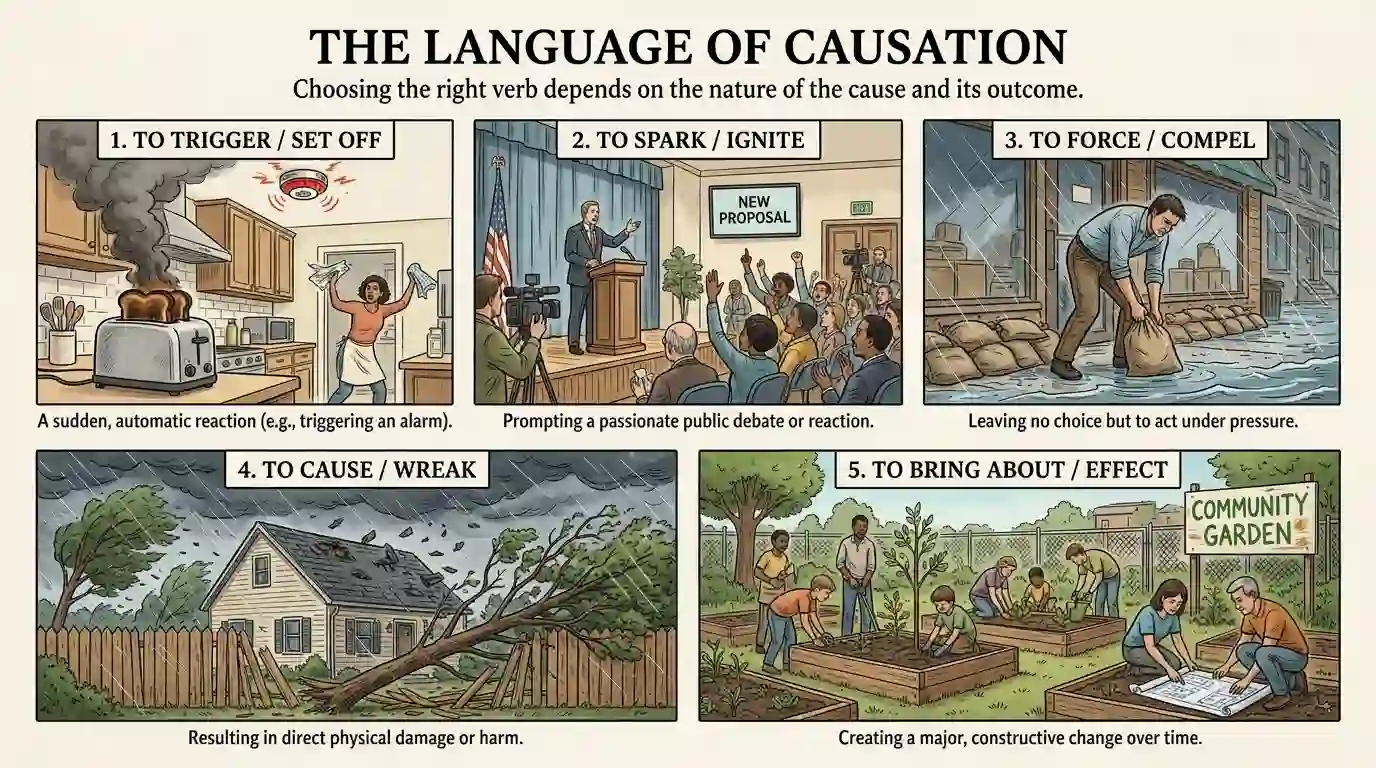
| If you want to… | Use | Why |
| Say it simply | leading to / bringing about | Both are clear and common |
| Show a sudden effect | triggering / setting off | They show a fast start |
| Show a strong public reaction | sparking / igniting | They fit debate and anger |
| Show pressure on a person | forcing / compelling | They show little choice |
| Show harm | inflicting / wreaking | They fit pain and damage |
| Show one cause among many | contributing to / accounting for | They show a share |
| Write in a formal style | engendering / precipitating | They fit reports |
| Show steady output | generating / producing | They fit power and results |
Exploring the Multiple Meanings of “Causing”

1. Making Something Happen
- Meaning: Bringing about a result.
- Explanation: This is the main sense of the participle. Etymonline dates the verb to the late 14th century.
- Example: The heavy rain is causing floods in the valley.
2. Making Someone Act
- Meaning: Making a person or thing do something.
- Explanation: Etymonline lists “impel, compel” as an early sense. People often follow it with “to.”
- Example: The noise is causing the horses to run away.
3. Bringing Trouble or Feeling
- Meaning: Giving rise to a problem, pain, or feeling.
- Explanation: This sense often goes with bad results. For example, people say causing worry or causing damage.
- Example: The delay is causing a lot of frustration at work.
4. Being the Reason
- Meaning: Being the source of an ongoing effect.
- Explanation: People ask “What is causing this?” to find a source. In this case, the participle shows an ongoing link.
- Example: What is causing that strange noise in the engine?
5. The Act of Causing
- Meaning: The act of making something happen, as a noun.
- Explanation: As a gerund, it works as a noun. Etymonline lists “causation” as the noun of action, from the 1640s.
- Example: Causing harm on purpose is against the law.
Analyzing 30 Causing Alternatives in Detail
Some choices are direct synonyms, while others only fit certain cases.
Everyday Choices
1. Leading to
IPA: US /ˈliːdɪŋ tu/ · UK /ˈliːdɪŋ tuː/
Definition: It means a step goes on to a later result. It also shows a path of events.
- Usage: It is a close match for slow or indirect cause. For example, poor sleep is leading to stress.
- Example: Heavy traffic is leading to long delays on the main road.
2. Bringing about
IPA: /ˈbrɪŋɪŋ əˈbaʊt/ (US and UK)
Definition: It means you make a change or event happen. It also suggests a lasting effect.
- Usage: It is a close, neutral match. However, it fits change better than harm.
- Example: The new law is bringing about big changes in schools.
3. Producing
IPA: US /prəˈdusɪŋ/ · UK /prəˈdjuːsɪŋ/
Definition: It means you cause a result to appear. It also can mean you make goods.
- Usage: It is a related choice for effects and reactions. In fact, it fits science well.
- Example: The heat is producing a strange smell in the room.
4. Creating
IPA: /kriˈeɪtɪŋ/ (US and UK)
Definition: It means you cause something to exist. It also shows you make something new.
- Usage: It is a related choice for new problems or feelings. However, it feels active and planned.
- Example: The loose wires are creating a risk of fire.
5. Resulting in
IPA: /rɪˈzʌltɪŋ ɪn/ (US and UK)
Definition: It means a cause ends in a certain result. It also shows the final outcome.
- Usage: It is a close choice in reports. Still, it focuses on the end, not the start.
- Example: The mistake is resulting in a two-day delay for everyone.
Sparking and Triggering Choices
6. Triggering
IPA: /ˈtrɪɡərɪŋ/ (US and UK)
Definition: It means you cause a quick reaction. It also suggests one clear first event.
- Usage: It is a close choice for sudden effects. For example, smoke is triggering the alarm.
- Example: Pollen is triggering allergies in many people this week.
7. Sparking
IPA: US /ˈspɑrkɪŋ/ · UK /ˈspɑːkɪŋ/
Definition: It means you cause something to start, often a strong reaction. It also suggests heat or energy.
- Usage: It is a figurative, related choice. For example, a speech is sparking debate.
- Example: The new rule is sparking anger among the parents.
8. Setting off
IPA: US /ˈsɛtɪŋ ˈɔf/ · UK /ˈsɛtɪŋ ˈɒf/
Definition: It means you cause an alarm or event to start. It also can mean you start a trip.
- Usage: It is an informal, related choice. However, it has other meanings, such as leaving.
- Example: Burnt toast keeps setting off the smoke alarm in the hall.
9. Prompting
IPA: US /ˈprɑmptɪŋ/ · UK /ˈprɒmptɪŋ/
Definition: It means you push someone to act. It also can mean you remind them.
- Usage: It is a gentle, related choice. However, it is weaker than “forcing.”
- Example: Her question is prompting a long talk about the plan.
10. Igniting
IPA: /ɪɡˈnaɪtɪŋ/ (US and UK)
Definition: It means you start a fire or strong feeling. It also shows quick growth.
- Usage: It is a figurative, related choice. For example, a rumor is igniting fear.
- Example: The song is igniting excitement in the crowd tonight.
Making People Act
11. Making
IPA: /ˈmeɪkɪŋ/ (US and UK)
Definition: It means you cause someone or something to do or be something. It also is very common.
- Usage: It is a close, everyday choice. However, it takes a bare verb, as in “making him laugh.”
- Example: The loud noise is making the baby cry again.
12. Forcing
IPA: US /ˈfɔrsɪŋ/ · UK /ˈfɔːsɪŋ/
Definition: It means you make someone act against their will. It also shows strong pressure.
- Usage: It is a related choice with a hard tone. However, it is stronger than “causing.”
- Example: The storm is forcing the airline to cancel all flights.
13. Compelling
IPA: /kəmˈpɛlɪŋ/ (US and UK)
Definition: It means you push someone to act by need or duty. It also can be very convincing.
- Usage: It is a formal, related choice. Still, it can have two meanings.
- Example: A sense of duty is compelling him to speak up.
14. Driving
IPA: /ˈdraɪvɪŋ/ (US and UK)
Definition: It means you push someone toward a state or act. It also shows strong force.
- Usage: It is a related choice for strong effects. For example, high prices are driving people away.
- Example: The high price is driving many shoppers to other stores.
15. Motivating
IPA: US /ˈmoʊtəˌveɪtɪŋ/ · UK /ˈməʊtɪveɪtɪŋ/
Definition: It means you give someone a reason to act. It also shows a push from inside.
- Usage: It is a related choice for people only. However, it is a positive word.
- Example: The coach’s words are motivating the team to work harder.
Harm and Trouble Choices
16. Inflicting
IPA: /ɪnˈflɪktɪŋ/ (US and UK)
Definition: It means you cause pain or damage to someone. It also suggests force.
- Usage: It is a formal, related choice for harm only. However, it sounds strong.
- Example: The storm is inflicting heavy damage on the coast.
17. Wreaking
IPA: /ˈriːkɪŋ/ (US and UK)
Definition: It means you cause great damage. It also is often paired with havoc.
- Usage: It is a related, dramatic choice. In fact, it often goes with havoc.
- Example: The flood is wreaking havoc on the small village.
18. Stirring up
IPA: US /ˈstɜrɪŋ ʌp/ · UK /ˈstɜːrɪŋ ʌp/
Definition: It means you cause trouble or strong feelings. It also can mean you mix something.
- Usage: It is an informal, related choice. For example, gossip is stirring up trouble.
- Example: His rude jokes are stirring up anger at the party.
19. Unleashing
IPA: /ʌnˈliːʃɪŋ/ (US and UK)
Definition: It means you set loose a strong force. It also shows a sudden release.
- Usage: It is a figurative, related choice. However, it fits big, wild effects.
- Example: The decision is unleashing a wave of criticism online.
20. Provoking
IPA: US /prəˈvoʊkɪŋ/ · UK /prəˈvəʊkɪŋ/
Definition: It means you cause anger or a reaction. It also shows you push on purpose.
- Usage: It is a related choice for people and feelings. However, it rarely fits things like storms.
- Example: His rude joke is provoking an angry reply.
Formal Choices
21. Engendering
IPA: US /ɛnˈdʒɛndərɪŋ/ · UK /ɪnˈdʒɛndərɪŋ/
Definition: It means you cause a feeling or state to exist. It also is a formal word.
- Usage: It is a close, formal choice. For example, honesty is engendering trust.
- Example: Her honesty is engendering trust among the staff.
22. Precipitating
IPA: US /prɪˈsɪpɪˌteɪtɪŋ/ · UK /prɪˈsɪpɪteɪtɪŋ/
Definition: It means you cause something to happen suddenly. It also suggests a crisis.
- Usage: It is a formal, related choice. However, it is rare in daily conversation.
- Example: The loss of the job is precipitating a money crisis.
23. Inducing
IPA: US /ɪnˈdusɪŋ/ · UK /ɪnˈdjuːsɪŋ/
Definition: It means you bring on a state, often by a drug or act. It also can mean you persuade.
- Usage: It is a related choice for medicine and science. For example, a drug is inducing sleep.
- Example: The tea is inducing a calm, sleepy mood.
24. Giving rise to
IPA: US /ˈɡɪvɪŋ ˈraɪz tu/ · UK /ˈɡɪvɪŋ ˈraɪz tuː/
Definition: It means you cause something to begin to exist. It also suggests slow growth.
- Usage: It is a close, formal choice. In fact, it fits ideas and problems.
- Example: New tools are giving rise to new kinds of work.
25. Effecting
IPA: /ɪˈfɛktɪŋ/ (US and UK)
Definition: It means you bring about a change. It also is a formal word.
- Usage: It is a formal, related choice. However, do not confuse it with “affecting.”
- Example: The manager is effecting several changes to the plan.
Source and Contribution Choices
26. Contributing to
IPA: /kənˈtrɪbjutɪŋ tə/ (US and UK)
Definition: It means you help cause a result. It also shows you are one cause of many.
- Usage: It is a close match when many causes exist. For example, stress is contributing to poor sleep.
- Example: Poor diet is contributing to his health problems.
27. Fueling
IPA: /ˈfjuːəlɪŋ/ (US and UK)
Definition: It means you feed a fire or strong feeling. It also makes something grow.
- Usage: It is a figurative, related choice. For example, rumors are fueling fear.
- Example: The cold winter is fueling demand for heat.
28. Accounting for
IPA: US /əˈkaʊntɪŋ fɔr/ · UK /əˈkaʊntɪŋ fɔː/
Definition: It means you are the reason for a part of something. It also can mean you explain it.
- Usage: It is a related choice. However, it often talks about a share or an explanation.
- Example: Rain is accounting for most of the delays this week.
29. Responsible for
IPA: US /rɪˈspɑnsəbəl fɔr/ · UK /rɪˈspɒnsəbəl fɔː/
Definition: It means you are the cause or you own the duty. It also can show blame.
- Usage: It is a related choice for people and things. However, it may carry blame.
- Example: A faulty switch is responsible for the power cut.
30. Generating
IPA: US /ˈdʒɛnəˌreɪtɪŋ/ · UK /ˈdʒɛnəreɪtɪŋ/
Definition: It means you cause something to be made or begin. It also fits power and ideas.
- Usage: It is a related choice for steady output. For example, wind is generating power.
- Example: The new campaign is generating a lot of interest online.
Causing vs. Leading to vs. Resulting in vs. Triggering
These phrases all link a cause to a result. They also differ in speed and tone. First, “causing” is direct.
Next, “leading to” often shows a slow path. “Triggering” shows a fast start. “Resulting in” points to the end.
| Phrase | Main Focus | Tone | Example |
| Causing | a direct link | Neutral | The rain is causing delays. |
| Leading to | a slow or indirect path | Neutral | Stress is leading to poor sleep. |
| Resulting in | the final outcome | Neutral to formal | The error is resulting in a fine. |
| Triggering | a quick first event | Neutral | Smoke is triggering the alarm. |
Causing and Opposite/Paired Word Pairs

| Word | Paired Word | Note |
| Causing | preventing | The clearest opposite |
| Causing | stopping | Fits events in progress |
| Causing | blocking | Fits a result held back |
| Causing | avoiding | Fits steering clear of a result |
| Causing | ending | Fits a cause that is removed |
| Causing | reducing | Fits a smaller effect |
| Causing | solving | Fits problems |
| Causing | curing | Fits illness |
“Causing” has several opposites because it has several senses. For example, “preventing” fits any result. On the other hand, “solving” fits problems and “curing” fits illness.
Common Word Partners of “Causing”

| Pattern | Common Partners | Example |
| causing + noun (trouble) | problems, delays, damage, harm, pain, confusion | The storm is causing delays. |
| causing + person + to | him, them, us, the baby | The noise is causing us to wake up. |
| what is causing + noun | this, the noise, the leak | What is causing the leak? |
| without causing + noun | harm, trouble, offense, damage | Wash it without causing damage. |
| blame for causing | the fire, the crash | Police blame him for causing the crash. |
| risk of causing | harm, injury, fire | There is a risk of causing injury. |
Idiomatic Phrases Featuring “Causing”
These phrases use the base word “cause.” They are established expressions, and “cause a stir” is the closest to an idiom.
1. Cause a stir
- Meaning: To make people talk or react with surprise or excitement.
- Example: The singer’s new look caused a stir at the awards.
2. Cause for concern
- Meaning: A reason to worry.
- Example: The doctor said the test results were not a cause for concern.
3. Make common cause
- Meaning: To join with others for a shared goal.
- Example: The two groups made common cause to save the park.
4. Cause and effect
- Meaning: The link between an event and its result.
- Example: The lesson shows the cause and effect of the war.
Word Formation of “Causing”
Etymology & Structure
“Causing” is the verb “cause” plus the ending -ing. Etymonline traces the verb to Old French “causer” and Medieval Latin “causare.” Both come from Latin “causa,” meaning cause or reason.
The origin of “causa” is unknown. Classical Latin “causari” meant to plead or debate a question.
Date and History
Etymonline dates the verb to the late 14th century, with the meaning “produce an effect” and “impel, compel.” The noun is from about 1200 to 1300. Dictionary.com gives 1175–1225 for the first record.
“Causal” is from the 1530s, and “causative” is from the early 15th century. “Causation” is from the 1640s. “Because” is from the late 14th century.
Word Class Variations
- Verb: cause, causes, caused, causing
- Noun: cause; causation; causer
- Adjective: causal; causative; causeless
- Adverb: causelessly
- Related words: because, ’cause
Common Word-Choice Mistakes

- “The rain is causing the game to be canceled”: “The rain is causing the game to be canceled.”
- “The noise is causing me a headache”: “The noise is causing me a headache.”
- “He is causing me worry”: “He is causing me worry.”
- “Smoking is causing cancer”: “Smoking is causing cancer.”
- “The heat is affecting the plants”: “The heat is affecting the plants.”
- “What is causing this?”: “What is causing this?”
- “The delay is caused by the storm”: “The storm is causing the delay.”
Frequently Asked Questions
What is the closest synonym for “causing”?
“Leading to” and “bringing about” are the closest. “Producing” is also close for effects.
What is the difference between “causing” and “leading to”?
“Causing” is direct. “Leading to” often shows a slower or less direct path.
What is the difference between “causing” and “triggering”?
“Triggering” suggests a quick start. “Causing” is more general.
What is a formal choice for “causing”?
“Engendering,” “precipitating,” and “inducing” fit formal writing. However, each one fits only some cases.
What is a casual choice for “causing”?
“Setting off” and “stirring up” are casual. They fit everyday talk.
What is the opposite of “causing”?
“Preventing” is the clearest opposite. “Stopping” also works.
Can “causing” describe people?
Yes. For example, “He is causing trouble” talks about a person’s acts.
Does “causing” always mean something bad?
No, but it often goes with problems. For good results, “leading to” or “bringing about” sounds better.
Which words fit the pressure on a person?
“Forcing” and “compelling” fit best. “Motivating” fits a positive push.
Can “causing” be a noun?
Yes. It can name the act, as in “Causing harm is wrong.”
Conclusion
The closest choices for “causing” are “leading to,” “bringing about,” and “producing.” Also, “triggering,” “sparking,” and “making” cover many cases. In short, each phrase shows one thing making another happen.
Context matters because the words differ in speed and tone. For example, “triggering” shows a fast start while “contributing to” shows one cause among many. However, “inflicting” fits only harm.
First, decide what kind of cause you mean. Next, pick the word that fits your tone. Finally, check the grammar, such as “causing him to leave.”
Sources: Etymonline, Merriam-Webster and Collins Dictionary.

Haleema Sadia is an experienced content writer with three years of expertise in English vocabulary, synonyms, and word meanings. At TrueVisite, she creates clear, accurate, and reader-friendly content that helps people expand their vocabulary, understand word usage, and communicate with greater confidence. Her goal is to make learning English simple, practical, and accessible to everyone.