

The closest plain choices for “focuses” are “concentrates” and “centers.” Both words show attention going to one point. In short, “emphasizes” also fits many cases.
The best choice depends on the meaning. You may mean care, a main topic, or a lens. Also, you may mean light or effort.
Quick list: concentrates, centers, zeroes in, emphasizes, highlights, targets, aims, directs, sharpens, addresses
This article looks at 30 choices. Each one has a meaning, IPA, a usage note, and an example. You will also find context notes and word history.
At a Glance: Focuses Synonyms and Related Alternatives
| Alternative | Part of Speech | Meaning | Register / Tone | Ideal Context |
| Concentrates | verb | gives full attention to one thing | Neutral | Study, work, thinking |
| Centers | verb | has one main point or topic | Neutral | Books, talks, plans |
| Zeroes in | phrasal verb | aims at one exact detail | Informal | Searches, problems |
| Pays attention | verb phrase | watches or listens with care | Everyday | Class, talks, tasks |
| Emphasizes | verb | shows that something matters most | Neutral | Reports, speeches |
| Highlights | verb | makes something stand out | Neutral | Reports, news |
| Targets | verb | aims at a goal or group | Neutral | Ads, plans, programs |
| Directs | verb | points effort toward a goal | Neutral | Energy, attention |
| Sharpens | verb | makes an image or idea clear | Neutral | Cameras, ideas |
| Addresses | verb | deals with a topic or problem | Neutral to formal | Laws, talks, writing |
Which Word Should You Use?

| If you want to… | Use | Why |
| Say someone pays close attention | concentrates / pays attention | They fit the mind |
| Say a text has one main topic | centers / addresses | They name the main subject |
| Say something stands out | emphasizes / highlights | They show importance |
| Aim effort at a goal | targets / directs / channels | They show direction |
| Narrow a search to one detail | zeroes in / narrows | They show a smaller range |
| Make an image or idea clear | sharpens / clarifies | They fit lenses and ideas |
| Say someone thinks too long about one thing | dwells / fixates | They show too much focus |
| Put one thing first | prioritizes / devotes | They show order and time |
Exploring the Multiple Meanings of “Focuses”

1. Pays Close Attention
- Meaning: Gives full attention to one thing.
- Explanation: This is the main sense. Etymonline dates the figurative sense of the verb to 1807.
- Example: She focuses on her work when the house is quiet.
2. Makes Something the Main Topic
- Meaning: Makes a thing the main subject or aim.
- Explanation: Writers often use “focuses on” for books, plans, and talks. For example, a plan focuses on cost.
- Example: The book focuses on the first year of the war.
3. Adjusts a Lens
- Meaning: Adjusts a lens or camera to make an image sharp.
- Explanation: Etymonline dates the optics verb to 1775. This was the first use of the verb.
- Example: He focuses the camera before the bird flies away.
4. Gathers Rays to a Point
- Meaning: Brings light or heat together at one point.
- Explanation: A lens or mirror can do this. In fact, the word comes from the Latin word for hearth.
- Example: A magnifying glass focuses sunlight into one bright dot.
5. A Plural Noun
- Meaning: More than one center of attention.
- Explanation: “Focuses” is one plural of the noun “focus.” Etymonline calls “foci” the classic plural.
- Example: The report has three main focuses for the next year.
Analyzing 30 Focused Alternatives in Detail

Some choices are direct synonyms, while others only fit certain cases.
Everyday Choices
1. Concentrates
IPA: US /ˈkɑnsənˌtreɪts/ · UK /ˈkɒnsəntreɪts/
Definition: It means you give all your attention to one thing. It also suggests deep effort.
- Usage: It is the closest plain match. However, it fits the mind best, not topics.
- Example: She concentrates on her homework after dinner each night.
2. Centers
IPA: US /ˈsɛntərz/ · UK /ˈsɛntəz/
Definition: It means something has one main point or topic. It also can mean you place it in the middle.
- Usage: It is a close match with “on.” Still, British writers spell it “centres.”
- Example: The story centers on a young girl and her dog.
3. Zeroes in
IPA: US /ˈziroʊz ɪn/ · UK /ˈzɪərəʊz ɪn/
Definition: It means you aim at one exact point or detail. It also shows you narrow your view.
- Usage: It is an informal, close match. For example, a coach zeroes in on one weak spot.
- Example: The doctor zeroes in on the cause of the pain.
4. Homes in
IPA: US /hoʊmz ɪn/ · UK /həʊmz ɪn/
Definition: It means you move toward one exact target. It also suggests you get close step by step.
- Usage: It is a related choice with “on.” In fact, it often fits searches.
- Example: The detective homes in on the one true suspect.
5. Pays attention
IPA: /peɪz əˈtɛnʃən/ (US and UK)
Definition: It means you watch or listen with care. It also shows you notice small details.
- Usage: It is a plain, close match for the mind sense. However, it is longer than “focuses.”
- Example: She pays attention to every word the teacher says.
Emphasis and Priority Choices
6. Emphasizes
IPA: US /ˈɛmfəˌsaɪzɪz/ · UK /ˈɛmfəsaɪzɪz/
Definition: It means you show that something is very important. It also makes people notice it.
- Usage: It is a close match for the topic sense. For example, a report emphasizes safety.
- Example: The new coach emphasizes teamwork in every practice session.
7. Highlights
IPA: US /ˈhaɪˌlaɪts/ · UK /ˈhaɪlaɪts/
Definition: It means you make something stand out. It also draws the eye to it.
- Usage: It is a related choice for drawing notice. However, it does not mean to study it deeply.
- Example: The report highlights three key problems with the plan.
8. Stresses
IPA: /ˈstrɛsɪz/ (US and UK)
Definition: It means you give strong weight to a point. It also shows you think it matters.
- Usage: It is a close, everyday match for emphasis. In fact, it is shorter than “emphasizes.”
- Example: The guide stresses the need to wash your hands.
9. Prioritizes
IPA: US /praɪˈɔrəˌtaɪzɪz/ · UK /praɪˈɒrɪtaɪzɪz/
Definition: It means you put something first in order of need. It also means you plan your time.
- Usage: It is a related choice for planning. For example, a manager prioritizes urgent tasks.
- Example: She prioritizes sleep during busy weeks at work.
10. Spotlights
IPA: US /ˈspɑtˌlaɪts/ · UK /ˈspɒtlaɪts/
Definition: It means you shine public attention on something. It also works for news and art.
- Usage: It is a related, figurative choice. However, it sounds bold and public.
- Example: The new documentary spotlights the daily lives of local farmers.
Aim and Direction Choices
11. Targets
IPA: US /ˈtɑrɡɪts/ · UK /ˈtɑːɡɪts/
Definition: It means you aim at a certain goal or group. It also shows you plan with care.
- Usage: It is a related choice for plans and ads. For example, a campaign targets young voters.
- Example: The program targets families with young children in town.
12. Aims
IPA: /eɪmz/ (US and UK)
Definition: It means you point your effort toward a goal. It also can mean you point a tool.
- Usage: It is a related choice. However, it needs “at” or “to” before the goal.
- Example: The school aims to help every child learn to read.
13. Directs
IPA: US /dəˈrɛkts/ · UK /dɪˈrɛkts/
Definition: It means you point something toward a place or goal. It also can mean you guide people.
- Usage: It is a close match for effort or attention. For example, she directs her energy to study.
- Example: He directs all his energy toward finishing the race.
14. Channels
IPA: /ˈtʃænəlz/ (US and UK)
Definition: It means you send energy or money in one direction. It also shows careful planning.
- Usage: It is a figurative, related choice. However, it fits resources more than attention.
- Example: The group channels its funds into local schools.
15. Devotes
IPA: US /dɪˈvoʊts/ · UK /dɪˈvəʊts/
Definition: It means you give time or effort to one thing. It also shows deep care.
- Usage: It is a close match for effort. In fact, it often goes with “to.”
- Example: She devotes every Saturday morning to her small garden.
Mental Effort Choices
16. Attends
IPA: /əˈtɛndz/ (US and UK)
Definition: It means you give careful thought to something. It also can mean you go to an event.
- Usage: It is formal and needs “to.” Still, it can also mean to be present.
- Example: The nurse attends to each patient with great care.
17. Dwells
IPA: /dwɛlz/ (US and UK)
Definition: It means you think about one thing for too long. It also often shows worry.
- Usage: It is a related choice, and it needs “on.” However, it sounds negative.
- Example: He dwells on small mistakes long after the game.
18. Fixates
IPA: US /ˈfɪkˌseɪts/ · UK /fɪkˈseɪts/
Definition: It means you can’t stop thinking about one thing. It also suggests a strong grip.
- Usage: It is a related choice with a harsh tone. In fact, it often shows too much focus.
- Example: She fixates on tiny details and loses the big picture.
19. Locks on
IPA: US /lɑks ˈɑn/ · UK /lɒks ˈɒn/
Definition: It means you fix your aim or gaze on one target. It also shows steady attention.
- Usage: It is an informal, related choice. For example, radar locks on a plane.
- Example: The camera locks on the runner’s face at the finish.
20. Tunes in
IPA: US /tunz ɪn/ · UK /tjuːnz ɪn/
Definition: It means you begin to pay attention. It also can mean you adjust a radio.
- Usage: It is a related, casual choice. However, it suggests listening more than thinking.
- Example: The class tunes in as soon as the story begins.
Lens and Light Choices
21. Sharpens
IPA: US /ˈʃɑrpənz/ · UK /ˈʃɑːpənz/
Definition: It means you make an image or idea clear. It also makes the edges crisp.
- Usage: It is a close match for the camera sense. For example, a lens sharpens the image.
- Example: The photographer sharpens the image before she prints it.
22. Clarifies
IPA: US /ˈklɛrəˌfaɪz/ · UK /ˈklærɪfaɪz/
Definition: It means you make something easier to see or grasp. It also removes doubt.
- Usage: It is a related choice for ideas. However, it does not mean to pay attention.
- Example: The teacher clarifies the rules before the game begins.
23. Converges
IPA: US /kənˈvɜrdʒɪz/ · UK /kənˈvɜːdʒɪz/
Definition: It means lines or rays meet at one point. It also can mean people gather.
- Usage: It is a close match for the light sense. For example, light converges at one point in a lens.
- Example: Light converges at one point behind the glass lens.
24. Gathers
IPA: US /ˈɡæðərz/ · UK /ˈɡæðəz/
Definition: It means you bring many things into one place. It also can mean you collect your thoughts.
- Usage: It is a related choice for light and energy. However, it fits objects better than ideas.
- Example: The mirror gathers sunlight into a single bright spot.
25. Narrows
IPA: US /ˈnɛroʊz/ · UK /ˈnærəʊz/
Definition: It means you make a range smaller. It also helps you pick one choice.
- Usage: It is a related choice, and it often takes “down.” In fact, it fits lists and searches.
- Example: She narrows her search to three small towns by the sea.
Subject and Theme Choices
26. Addresses
IPA: /əˈdrɛsɪz/ (US and UK)
Definition: It means you deal with a topic or problem. It also can mean you speak to a group.
- Usage: It is a related choice for topics. However, it suggests a problem to solve.
- Example: The new law addresses the problem of unsafe roads.
27. Explores
IPA: US /ɪkˈsplɔrz/ · UK /ɪkˈsplɔːz/
Definition: It means you look into a topic in depth. It also shows curiosity.
- Usage: It is a related choice for books and shows. For example, a film explores grief.
- Example: The documentary explores how people live in the Arctic.
28. Examines
IPA: /ɪɡˈzæmɪnz/ (US and UK)
Definition: It means you look at something closely. It also may include tests.
- Usage: It is a related, formal choice. However, it shows study, not just a main topic.
- Example: The study examines how sleep affects school grades.
29. Deals with
IPA: /diːlz wɪð/ (US and UK)
Definition: It means a text or talk covers a topic. It also can mean you handle a task.
- Usage: It is a plain, related choice. In everyday English, it is very common.
- Example: The first chapter deals with the early years of the city.
30. Revolves around
IPA: US /rɪˈvɑlvz əˈraʊnd/ · UK /rɪˈvɒlvz əˈraʊnd/
Definition: It means the main parts are built around one idea. It also suggests a fixed center.
- Usage: It is a figurative, related choice. For example, a story revolves around one family.
- Example: The whole plot revolves around a lost key in the attic.
Focuses on vs. Centers on vs. Concentrates on

These phrases overlap. They also differ in feel. First, “concentrate on” fits the mind best.
Next, “centers on” fits topics. “Zeroes in on” fits one small detail.
| Phrase | Best For | Tone | Example |
| Focuses on | topics, attention, and lenses | Neutral | The class focuses on writing. |
| Concentrates on | mental effort | Neutral | She concentrates on her test. |
| Centers on | the main subject | Neutral | The film centers on a boy. |
| Zeroes in on | one small detail | Informal | He zeroes in on the error. |
Focuses and Opposite/Paired Word Pairs
| Word | Paired Word | Note |
| Focuses | ignores | The clearest opposite for attention |
| Focuses | wanders | Fits a mind that drifts |
| Focuses | blurs | Fits lenses and images |
| Focuses | scatters | Fits attention spread out |
| Focuses | broadens | Fits a wider view |
| Focuses | overlooks | Fits a missed detail |
| Focuses | neglects | Fits a task left alone |
| Focuses | drifts | Fits a goal or mind that moves away |
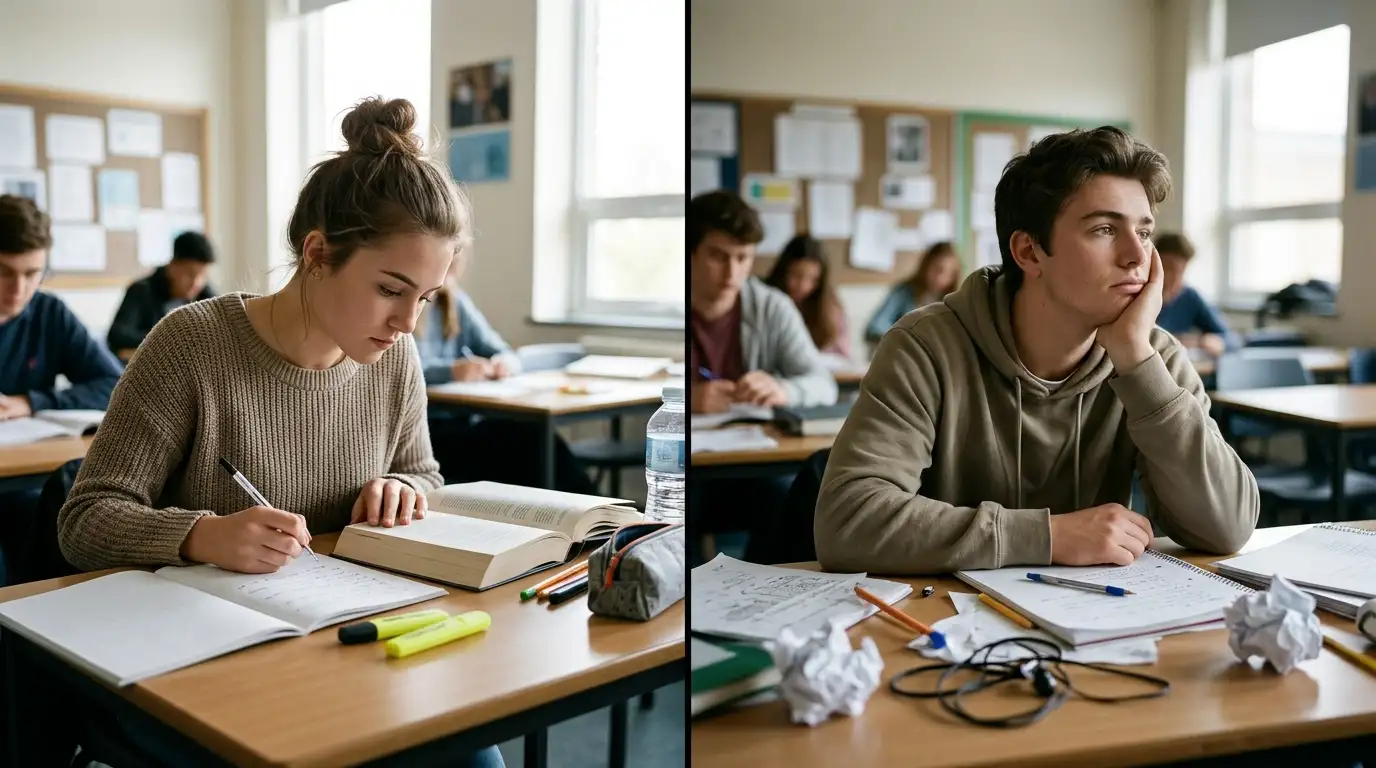
“Focuses” has several opposites because it has several senses. For example, “ignores” fits attention. On the other hand, “blurs” fits a lens.
Common Word Partners of “Focuses”

| Pattern | Common Partners | Example |
| subject + focuses on | report, study, book, course, program | The study focuses on sleep. |
| person + focuses on | task, goal, future, work | He focuses on his goals. |
| focuses + attention / energy | attention, energy, efforts, mind | She focuses her energy on one goal. |
| adverb + focuses on | mainly, mostly, primarily, closely | The class mainly focuses on writing. |
| lens / device + focuses | camera, lens, mirror, light | The lens focuses light onto the sensor. |
| focuses on + question word | how, what, why | The talk focuses on how people learn. |
Idiomatic Phrases Featuring “Focuses”

These phrases use the base word “focus.” They are common fixed phrases, not strict idioms.
1. Come into focus
- Meaning: To become clear, like an image or an idea.
- Example: After a long talk, the plan finally came into focus.
2. Out of focus
- Meaning: Blurry, or not clear.
- Example: The photo is out of focus, so I took another.
3. Focus group
- Meaning: A small group that gives opinions about a product or idea.
- Example: The firm asked a focus group to test the new snack.
4. Narrow the focus
- Meaning: To make the topic or aim smaller and more exact.
- Example: The team had to narrow the focus of the study.
Word Formation of “Focuses”

Etymology & Structure
“Focuses” is the verb “focus” plus the ending -es. It is also a plural of the noun “focus.” Etymonline traces the noun to Latin “focus,” meaning hearth or fireplace.
The Latin word is of unknown origin. In fact, “curfew” also comes from the same root through French “feu.”
Date and History
Etymonline dates the noun to the 1640s. Kepler used it in 1604 for a point of convergence. The sense of a center of activity was first recorded in 1796.
The verb is from 1775 in optics. The figurative sense is from 1807. Intransitive use is from 1864.
Word Class Variations
- Verb: focus, focuses, focused, focusing (also focussed and focussing)
- Noun: focus; focuses; foci
- Adjective: focal; focused; unfocused
- Related words: refocus, autofocus
Common Word-Choice Mistakes

- “She focuses on her work”: “She focuses on her work.”
- “He focuses on the problem”: “He focuses on the problem.”
- “The book focuses on history”: “The book focuses on history.”
- “They are focusing on finishing”: “They are focusing on finishing.”
- “The report emphasizes costs”: “The report emphasizes costs.”
- “She concentrates on her work”: “She concentrates on her work.”
- “The camera concentrates on her face”: “The camera focuses on her face.”
Frequently Asked Questions
What is the closest synonym for “focuses”?
“Concentrates” and “centers” are the closest. “Pays attention” is the plainest choice.
What is the difference between “focuses” and “concentrates”?
“Concentrates” is about mental effort. “Focuses” also fits topics and lenses.
What is the difference between “focuses on” and “centers on”?
“Centers on” fits the main subject. “Focuses on” also fits attention and cameras.
What is a formal choice for “focuses”?
“Emphasizes,” “addresses,” and “examines” fit formal writing. However, each one fits only some cases.
What is a casual choice for “focuses”?
“Zeroes in” and “homes in” are casual. They show a narrow, exact aim.
What is the opposite of “focuses”?
“Ignores” and “overlooks” are the clearest. For lenses, “blurs” fits best.
Which word comes after “focuses”?
“On” is the usual word. For example, “focuses on” a task or a topic.
Can “focuses” be a noun?
Yes. It is a plural of “focus.” The classic plural is “foci.”
Can “focuses” mean adjusting a camera?
Yes. Etymonline dates this sense to 1775.
Which words fit goals and effort?
“Targets,” “aims,” “directs,” and “channels” fit best. Also, “devotes” fits time and care.
Conclusion
The closest choices for “focuses” are “concentrates” and “centers.” Also, “emphasizes,” “targets,” and “pays attention” cover many cases. In short, each word shows attention or effort going to one point.
Context matters because the words differ in meaning. For example, “sharpens” fits a lens while “dwells” shows too much thought. However, “addresses” fits topics and problems.
First, decide what you mean. Next, pick the word that fits your tone. Finally, check the word that follows, such as “on.”
Sources: Etymonline, Merriam-Webster and Collins Dictionary.
Haleema Sadia is an experienced content writer with three years of expertise in English vocabulary, synonyms, and word meanings. At TrueVisite, she creates clear, accurate, and reader-friendly content that helps people expand their vocabulary, understand word usage, and communicate with greater confidence. Her goal is to make learning English simple, practical, and accessible to everyone.