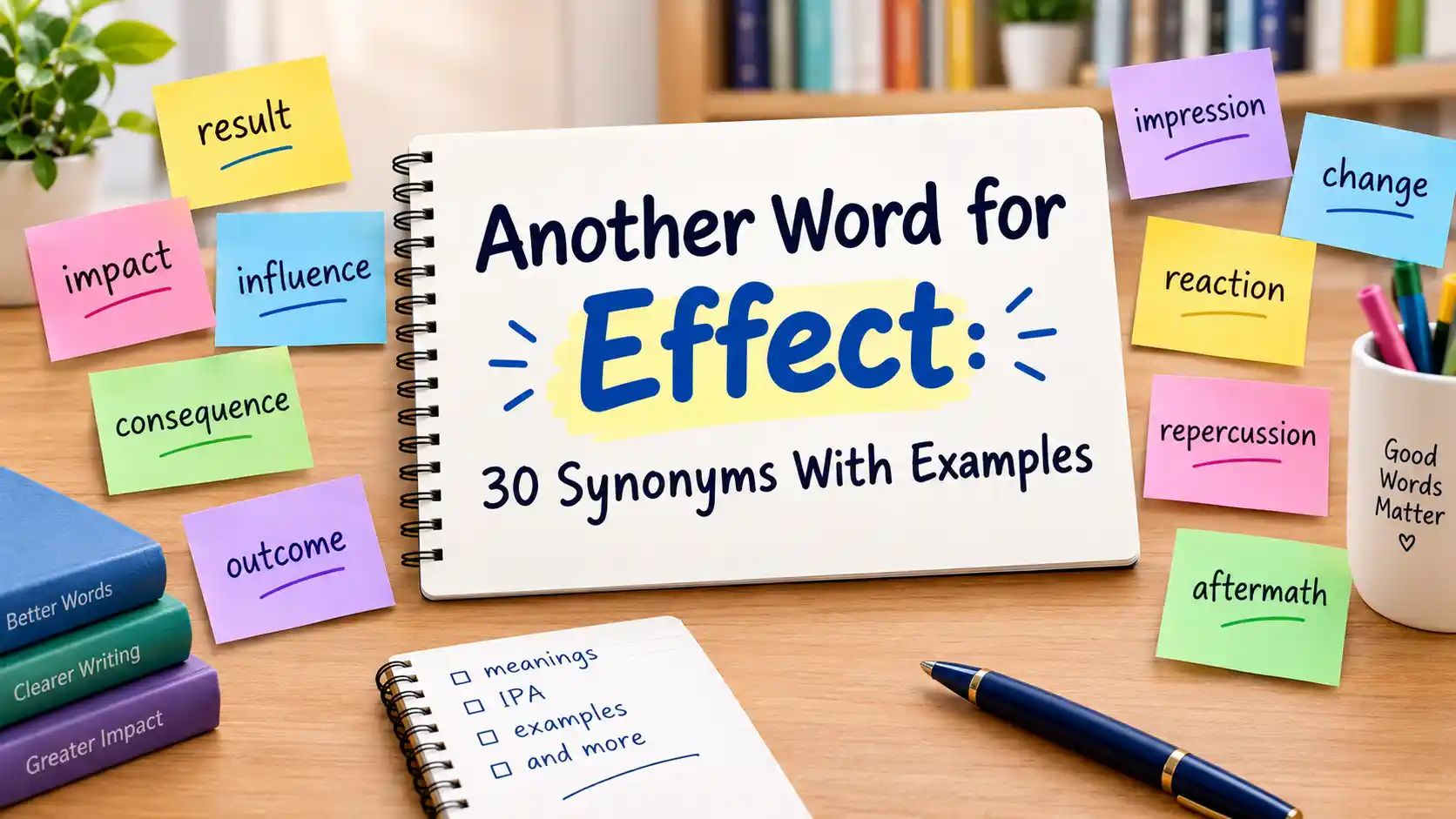
The closest alternatives for effect are result, impact, consequence, outcome, and influence. These words describe what happens because of an action, event, or decision. However, effect can also mean an impression, a change in someone’s feelings, a visual or sound feature, or the act of making something happen.
The best alternative depends on your sentence. Use result for what happens, impact for a strong or important change, consequence for what follows an action, and influence when something affects a person, decision, or situation. In science, writing, business, and everyday speech, choosing the right word helps make your meaning clear.
Quick list: Result, impact, consequence, outcome, influence, impression, change, reaction, repercussion, aftermath.
This guide explains 30 alternatives with definitions, IPA pronunciations, usage notes, and natural examples. It also covers common expressions, word partnerships, word history, and the important difference between effect and affect.
At a Glance: Effect Synonyms and Related Alternatives
| Alternative | Part of Speech | Meaning | Register / Tone | Ideal Context |
| Result | Noun | Something that happens because of an action | Neutral | Everyday writing |
| Impact | Noun | A strong or noticeable effect | Neutral / professional | Business, society |
| Consequence | Noun | Something that follows an action | Neutral / formal | Decisions, behavior |
| Outcome | Noun | The final result of an event or process | Neutral / professional | Projects, studies |
| Influence | Noun | Power to affect someone or something | Neutral / formal | Behavior, decisions |
| Impression | Noun | An effect on the mind or feelings | Neutral | Art, communication |
| Change | Noun | A difference from an earlier state | Neutral | General use, science |
| Reaction | Noun | A response to an action or event | Neutral | People, chemistry |
| Repercussion | Noun | A further, often unwanted, consequence | Formal | Politics, business |
| Aftermath | Noun | The period or situation following an event | Neutral / serious | Disasters, conflict |
Which Word Should You Use?

| If you want to… | Use | Why |
| Describe what happened because of an action | Result | A clear, everyday word for an outcome. |
| Emphasize a strong change | Impact | Highlights the importance or strength of the change. |
| Explain what follows a decision | Consequence | Often suggests a later or important result. |
| Describe the final result of a process | Outcome | Focuses on how something ends. |
| Explain how something shapes behavior | Influence | Emphasizes the power to affect a person or situation. |
| Describe a feeling created by art or words | Impression | Focuses on what someone thinks or feels. |
| Discuss an unwanted later result | Repercussion | Often suggests a serious or negative consequence. |
| Describe a visual or sound feature | Effect | Often the most accurate word for a special feature, such as a sound effect. |
Exploring the Multiple Meanings of “Effect”
The noun effect has several meanings. The most common is a result caused by an action or event, but it can also refer to an impression, a working condition, or a special feature in art and entertainment. It can also be used as a verb meaning to bring something about.
1. A Result Caused by Something

- Meaning: Something that happens because of an action, event, or cause.
- Explanation: This is the most common meaning of effect. It is closely related to result, outcome, and consequence, although these words differ slightly in use.
- Example: Regular practice had a positive effect on her writing.
2. A Strong Change or Influence

- Meaning: The power or result of changing a person, object, or situation.
- Explanation: In this sense, effect often describes how strongly something changes another thing. Impact and influence are common alternatives.
- Example: The new policy had a major effect on small businesses.
3. An Impression on the Mind or Senses

- Meaning: A feeling, thought, or appearance created by something.
- Explanation: This meaning is common in art, music, speech, photography, and design. Impression may fit when the focus is on what an audience experiences.
- Example: The soft lighting created a peaceful effect in the room.
4. A Feature in Art, Film, or Sound

- Meaning: A visual, sound, or other feature used to create a particular experience.
- Explanation: Expressions such as special effect, sound effect, and visual effect describe features added to entertainment or media. These are not always interchangeable with impact or result.
- Example: The film uses sound effects to make the storm seem real.
5. A State of Being Active or Official
- Meaning: The condition of being in operation or legally active.
- Explanation: This meaning often appears in phrases such as take effect, come into effect, and in effect. Here, operation or force may be related alternatives.
- Example: The new rules will take effect next month.
6. To Bring Something About
- Meaning: As a verb, effect means to cause or achieve something.
- Explanation: This formal verb is different from affect, which usually means to influence something. You can effect a change by bringing it about, but something may affect a change only in less common or different constructions.
- Example: The two sides worked together to effect a peaceful settlement.
Analyzing 30 Effect Alternatives in Detail
The following alternatives cover results, changes, emotional impressions, and consequences. Some are close synonyms, while others apply only to specific meanings of effect.
Group 1: Common Words for Results
1. Result
IPA: US /rɪˈzʌlt/ · UK /rɪˈzʌlt/
Definition: Something that happens because of an action, event, or process.
- Usage: One of the closest everyday synonyms for effect. It can describe immediate or long-term outcomes.
- Example: The new study method produced better results.
2. Outcome
IPA: US /ˈaʊtkʌm/ · UK /ˈaʊtkʌm/
Definition: The final result of an event, process, or situation.
- Usage: Best when you want to emphasize how something ends, especially when the result is uncertain.
- Example: The outcome of the meeting surprised everyone.
3. Consequence
IPA: US /ˈkɑːnsəkwens/ · UK /ˈkɒnsɪkwəns/
Definition: Something that happens because of an action or event.
- Usage: A close synonym, often used when discussing the wider or later results of a decision. It can suggest a negative result, but it is not always negative.
- Example: One consequence of poor planning was a delayed launch.
4. Impact
IPA: US /ˈɪmpækt/ · UK /ˈɪmpækt/
Definition: A strong or noticeable effect on someone or something.
- Usage: Use this when the result is important, powerful, or far-reaching. It often emphasizes the strength of the change.
- Example: The campaign had a major impact on public awareness.
5. Aftermath
IPA: US /ˈæftərmæθ/ · UK /ˈɑːftəmæθ/
Definition: The situation that follows a major, often unpleasant, event.
- Usage: A contextual alternative for the effects left behind after a crisis, disaster, or conflict. It refers to the wider situation, not simply one result.
- Example: The town struggled to rebuild in the aftermath of the flood.
Group 2: Words for Influence and Change
6. Influence
IPA: US /ˈɪnfluəns/ · UK /ˈɪnfluəns/
Definition: The power to affect a person, thing, or situation.
- Usage: Best when something shapes behavior, choices, or development. It can describe the process of affecting something as well as the power behind it.
- Example: Her parents had a strong influence on her career choice.
7. Change
IPA: US /tʃeɪndʒ/ · UK /tʃeɪndʒ/
Definition: A difference in the condition, form, or nature of something.
- Usage: A simple alternative when the effect involves a difference from an earlier state. It does not necessarily identify what caused that difference.
- Example: The new timetable brought a welcome change to school life.
8. Difference
IPA: US /ˈdɪfərəns/ · UK /ˈdɪfrəns/
Definition: A way in which people or things are not the same.
- Usage: Use this when an effect can be seen by comparing two situations. The phrase make a difference often means to have a useful or noticeable effect.
- Example: A little extra practice made a real difference to her score.
9. Action
IPA: US /ˈækʃən/ · UK /ˈækʃən/
Definition: Something done or a process of doing something.
- Usage: Action is not a direct synonym for effect: it usually refers to what is done, rather than what happens because of it. Use it when discussing a cause.
- Example: The team’s quick action prevented further damage.
10. Response
IPA: US /rɪˈspɑːns/ · UK /rɪˈspɒns/
Definition: A reaction or reply to something that has happened or been said.
- Usage: A related alternative when the effect is a reaction from a person, group, or system. It focuses on the reaction rather than the original cause.
- Example: The announcement received a positive response from customers.
Group 3: Emotional and Perceptual Effects
11. Impression
Definition: An idea, feeling, or opinion formed about someone or something.
IPA: US /ɪmˈprɛʃən/ · UK /ɪmˈpreʃən/
- Usage: A close alternative when effect refers to the feeling created in an audience or observer. It can also refer to an opinion formed about someone.
- Example: The speaker made a strong impression on the audience.
12. Reaction
IPA: US /riˈækʃən/ · UK /riˈækʃən/
Definition: A response to an event, action, substance, or experience.
- Usage: Use this when the effect is a person’s response or a process caused by something else. In science, it can have a more specific meaning.
- Example: Her reaction to the news was one of relief.
13. Feeling
IPA: US /ˈfiːlɪŋ/ · UK /ˈfiːlɪŋ/
Definition: An emotional state or sensation.
- Usage: A related alternative when an effect describes the emotion created by music, words, or an experience. It is narrower than the effect.
- Example: The music created a feeling of calm.
14. Sensation
IPA: US /sɛnˈseɪʃən/ · UK /senˈseɪʃən/
Definition: A physical feeling or a strong feeling of interest and excitement.
- Usage: Appropriate when an effect is a physical experience or a powerful public reaction. It is not a general substitute for every kind of effect.
- Example: The cool breeze created a pleasant sensation on her skin.
15. Impressionistic Effect
IPA: US /ˌɪmprəˌsɪˈstɪk ɪˈfɛkt/ · UK /ˌɪmprəˌsɪˈstɪk ɪˈfekt/
Definition: An impression created through suggestion, mood, or a loose rather than highly detailed representation.
- Usage: This is a descriptive phrase, not a single-word synonym. It fits discussions of art, photography, and writing when the intended effect is atmospheric rather than exact.
- Example: The blurred colors give the painting an impressionistic effect.
Group 4: Further or Unwanted Consequences
16. Repercussion
IPA: US /ˌriːpərˈkʌʃən/ · UK /ˌriːpəˈkʌʃən/
Definition: An indirect or later effect, often an unwanted one.
- Usage: Use this for consequences that spread beyond the immediate result, especially in social, political, or professional situations.
- Example: The decision had serious repercussions for the entire team.
17. Ramification
IPA: US /ˌræməfəˈkeɪʃən/ · UK /ˌræmɪfɪˈkeɪʃən/
Definition: A possible consequence or result of an action or decision.
- Usage: Often used in formal writing when discussing the wider implications of a decision. It commonly appears in the plural.
- Example: The company considered the legal ramifications of the agreement.
18. Fallout
IPA: US /ˈfɔːlˌaʊt/ · UK /ˈfɔːlaʊt/
Definition: Unpleasant results that follow an event or decision.
- Usage: An informal alternative for negative consequences, especially after controversy, conflict, or failure. It is not suitable for every neutral effect.
- Example: The company faced public criticism in the fallout from the scandal.
19. Sequel
IPA: US /ˈsiːkwəl/ · UK /ˈsiːkwəl/
Definition: Something that follows or develops from an earlier event.
- Usage: A limited, context-specific alternative. It can refer to a later event or a continuation, but it is not a general synonym for effect.
- Example: The first discovery led to a sequel of experiments that tested the theory.
20. By-product
IPA: US /ˈbaɪˌprɑːdʌkt/ · UK /ˈbaɪˌprɒdʌkt/
Definition: Something produced as a secondary result of making or doing something else.
- Usage: Use this when a result is not the main purpose of an action or process. A by-product can be useful, harmless, or harmful.
- Example: Extra heat is a by-product of the machine’s operation.
Group 5: Results in Formal, Scientific, and Technical Contexts
21. Implication
IPA: US /ˌɪmplɪˈkeɪʃən/ · UK /ˌɪmplɪˈkeɪʃən/
Definition: A possible consequence or a meaning suggested by something.
- Usage: A useful alternative when discussing what a finding or decision may mean for the future. It can also refer to an unstated meaning, so context matters.
- Example: The study’s findings have important implications for education.
22. Efficacy
IPA: US /ˈɛfɪkəsi/ · UK /ˈefɪkəsi/
Definition: The ability to produce an intended result.
- Usage: Related to the effectiveness of a cause or treatment, rather than the result itself. It is common in medical and scientific writing.
- Example: Researchers tested the efficacy of the new treatment.
23. Function
IPA: US /ˈfʌŋkʃən/ · UK /ˈfʌŋkʃən/
Definition: The purpose or activity of a person or thing.
- Usage: Not a direct synonym for effect. Use it when the intended meaning is what something does or is designed to do, rather than what it causes.
- Example: One function of the filter is to remove dust from the air.
24. Phenomenon
IPA: US /fəˈnɑːməˌnɑːn/ · UK /fəˈnɒmɪnən/
Definition: An observable event, fact, or process.
- Usage: A contextual alternative when discussing a named or observed effect in science. A phenomenon is the event being observed, not necessarily its result.
- Example: The researchers studied the phenomenon under controlled conditions.
25. Efficacy Effect
IPA: US /ˈɛfɪkəsi ɪˈfɛkt/ · UK /ˈefɪkəsi ɪˈfekt/
Definition: Not a standard fixed term; it can describe an effect related to a treatment’s ability to achieve a goal.
- Usage: This phrase is not recommended as a general synonym. Prefer treatment effect when describing a treatment’s result, and efficacy when describing its ability to work.
- Example: The study measured the treatment effect rather than using the vague phrase “efficacy effect.”
Group 6: Visual, Practical, and Action-Based Meanings
26. Feature
IPA: US and UK /ˈfiːtʃər/
Definition: A noticeable part, quality, or characteristic of something.
- Usage: A contextual alternative when effect refers to a specific feature in a film, design, or presentation. It does not necessarily mean a result or consequence.
- Example: The lighting feature helped create a dramatic scene.
27. Display
IPA: US and UK /dɪˈspleɪ/
Definition: A presentation or showing of something.
- Usage: Related to effect when a visual presentation is the focus, but it refers to what is shown rather than the impression it produces.
- Example: The light display transformed the building at night.
28. Performance
IPA: US /pərˈfɔːrməns/ · UK /pəˈfɔːməns/
Definition: The way someone or something works or carries out an activity.
- Usage: A contextual alternative when the intended effect concerns how well something operates. It is not a direct synonym for the result itself.
- Example: The software update improved the system’s performance.
29. Achievement
IPA: US /əˈtʃiːvmənt/ · UK /əˈtʃiːvmənt/
Definition: Something successfully completed or accomplished.
- Usage: Use this when the effect is a positive result that requires effort. It adds the idea of success, which effect alone does not carry.
- Example: Completing the project on time was a major achievement.
30. Fulfillment
IPA: US /fʊlˈfɪlmənt/ · UK /fʊlˈfɪlmənt/
Definition: The achievement of a wish, goal, need, or requirement.
- Usage: A related alternative when the effect involves satisfying a goal or requirement. It is not a general substitute for effect.
- Example: The new agreement led to the fulfillment of several long-standing commitments.
Effect vs. Affect vs. Result vs. Consequence
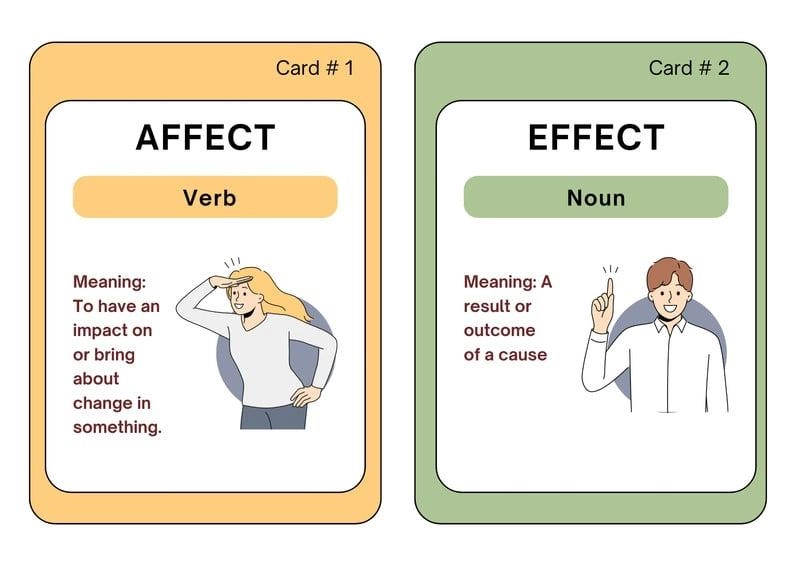
These four words are often confused because they describe connected parts of a cause-and-result relationship. The key is to identify whether you mean the cause, the result, or the wider meaning of what follows.
| Word | Main Meaning | Example |
| Effect | A result or change caused by something | The medicine had a positive effect. |
| Affect | Usually, to influence or change something | Lack of sleep can affect your concentration. |
| Result | Something that happens because of an action | The result was better than expected. |
| Consequence | Something that follows an action or event | One consequence was a higher cost. |
| Impact | A strong or noticeable effect | The change had a major impact. |
| Influence | The power to shape a person or situation | Her advice had a positive influence on him. |
A simple way to remember the difference
- Effect is usually a noun: “The change had an effect.”
- Affect is usually a verb: “The change affected sales.”
- Result often refers to what an action produces.
- Consequence often highlights what follows an action, especially its wider implications.
- Impact emphasizes the strength or importance of a change.
Remember that effect can also be a verb meaning to bring something about, as in “The leaders effected a change in policy.” This is a formal use, but it is correct.
Effect and Opposite/Paired Word Pairs
The usual opposite of effect is caused when discussing the relationship between what makes something happen and what happens as a result. Other useful contrasts depend on the specific meaning.
| Word | Paired Word | Note |
| Cause | Effect | The cause produces the effect. |
| Action | Reaction | An action may lead to a response. |
| Input | Output | What goes into a system versus what comes out. |
| Benefit | Harm | A positive result versus a damaging result. |
| Advantage | Disadvantage | A helpful result versus an unfavorable one. |
| Increase | Decrease | A rise versus a fall in a measurable value. |
| Improvement | Deterioration | A better state versus a worse state. |
| Success | Failure | A favorable result versus an unsuccessful one. |
| Positive effect | Negative effect | A beneficial result versus a harmful result. |
| Intended effect | Unintended effect | A planned result versus one that was not planned. |
These pairs are not all strict antonyms of effect. For example, increase and decrease describe opposite changes, while cause and effect express a relationship between two parts of an event.
Common Word Partners of “Effect”
Certain adjectives and verbs commonly appear with effect. Learning these combinations helps you write naturally and choose the right synonym for your meaning.
| Pattern | Common Partners | Example |
| Adjective + effect | positive, negative, harmful | The policy had a positive effect on attendance. |
| Adjective + effect | significant, major, dramatic | The change had a significant effect on costs. |
| Adjective + effect | immediate, lasting, long-term | Exercise can have lasting effects on health. |
| Adjective + effect | side, adverse, unintended | The treatment may have side effects. |
| Verb + effect | have, produce, create | The new rule produced the desired effect. |
| Verb + effect | cause, reduce, minimize | Better planning can reduce the effect of delays. |
| Verb + effect | achieve, enhance, amplify | The lighting enhanced the dramatic effect. |
| Effect + of + noun | exercise, pollution, stress | The effects of stress can vary from person to person. |
| Effect + on + noun | health, behavior, performance | The change had an effect on performance. |
| Effect + in + noun | practice, operation, policy | The new rules are now in effect. |
Idiomatic Phrases Featuring “Effect”
English has several established expressions containing effects. Some describe a result, while others refer to something becoming active or being implemented. These are fixed expressions rather than simple synonyms.
1. Take Effect
- Meaning: To begin to operate or produce a result.
- Example: The new safety rules will take effect on Monday.
2. In Effect
- Meaning: In operation, legally active, or true in practical terms.
- Example: The updated policy is now in effect.
3. Come Into Effect
- Meaning: To begin to operate or become officially active.
- Example: The new regulations will come into effect next year.
4. Put Into Effect
- Meaning: To make a plan, rule, or decision active or operational.
- Example: The school put its new attendance policy into effect.
These expressions are especially common in legal, business, administrative, and everyday writing. Remember that take effect often describes something becoming active, while put into effect describes someone making it active.
Word Formation of “Effect”
Etymology & Structure
The word effect entered English through Old French efet, from Latin effectus, meaning accomplishment, performance, or something achieved. It is linked to the Latin verb efficere, meaning to accomplish or bring about, formed from elements associated with “out” and “do.”
The central idea is bringing something about. Over time, effect developed meanings related to results, influence, impressions, and the operation of rules or systems.
Date and History
The noun effect is recorded in English from the mid-14th century. Its early meanings included the completion of an act and something achieved as a result. The verb meaning “to bring about” appeared in the late 16th century. The meaning involving an impression on an observer is recorded from the 18th century, while the use in expressions such as sound effect developed later.
Word Class Variations
| Word Form | Part of Speech | Meaning / Example |
| Effect | Noun | A result: The change had an effect. |
| Effect | Verb | To bring something about: They effected a compromise. |
| Effects | Plural noun | Results or, in some contexts, personal belongings |
| Effected | Past tense / participle | The reform effected major changes. |
| Effecting | Present participle / gerund | Effecting change requires action. |
| Effective | Adjective | Producing the intended result |
| Effectively | Adverb | In a way that produces the intended result |
| Effectiveness | Noun | The quality of producing the intended result |
| Effectiveness-related | Adjective phrase | Related to how well something works; not a single standard derivative |
| Effectual | Adjective | Producing the desired result |
| Effectuate | Verb | To bring something into effect or make it happen |
| Ineffective | Adjective | Not producing the intended result |
Common Word-Choice Mistakes
- Wrong: The medicine had a good effect. Correction: The medicine had a good effect.
- Wrong: The new rule affected my daily routine. Correction: The new rule affected my daily routine.
- Wrong: The consequence was the immediate cause. Correction: The cause produced the effect; the consequence followed from it.
- Wrong: The effect of the meeting was that everyone reacted. Correction: The meeting prompted a reaction from everyone, if you mean their response.
- Wrong: The policy took impact yesterday. Correction: The policy took effect yesterday.
- Wrong: The effect was very effective. Correction: The measure was effective, or it produced a strong effect, depending on your meaning.
- Wrong: The visual result was a sound effect. Correction: Use visual effect for an image or appearance and sound effect for a sound.
Frequently Asked Questions
1. What is the closest synonym for effect?
Result is one of the closest everyday synonyms. Impact, consequence, and outcome are also useful, depending on the sentence.
2. What is a formal alternative to effect?
Consequence, implication, repercussion, and ramification can work in formal writing. Each emphasizes a slightly different kind of result or wider meaning.
3. What is another word for a positive effect?
Use benefit, advantage, improvement, or positive impact. Choose benefits when you want to emphasize something helpful.
4. What is another word for a negative effect?
Harm, adverse impact, drawback, and repercussion may fit. Repercussion often suggests an additional or later unwanted result.
5. What is the difference between effect and impact?
Effect is a broad term for a result or change. Impact often emphasizes a strong, important, or noticeable change.
6. What is the difference between effect and consequence?
An effect can be an immediate result of a cause. A consequence often refers to something that follows an action or event, sometimes at a later stage.
7. What is the opposite of the effect?
Cause is the most common paired opposite in cause-and-effect relationships. In other contexts, the appropriate contrast might be benefit versus harm or improvement versus deterioration.
8. Can effect be used as a verb?
Yes. The formal verb effect means to bring something about, as in “The leaders effected a change.” By contrast, affect usually means to influence something.
9. What is another word for the effect of medicine?
Depending on the meaning, use result, response, reaction, or impact. In medical writing, side effect refers to an additional effect that is not the main intended benefit of a medicine.
10. What is the difference between effect and affect?
Effect is usually a noun meaning a result. Affect is usually a verb meaning to influence or change something, although both words have less common uses in other grammatical roles.
Conclusion
The most useful alternatives for effect include result, impact, consequence, outcome, and influence. For emotional or visual meanings, impression, reaction, and sensation may fit better. For later or unwanted results, consider repercussion, ramification, or fallout.
However, these alternatives are not interchangeable in every sentence. A result is what happens, an impact often emphasizes the strength of a change, and a consequence highlights what follows an action. In technical writing, the precise meaning matters even more.
To choose the right word, consider what kind of effect you mean: a result, a change, an emotional impression, or an event becoming active. Matching the word to the context makes your writing clearer and more accurate.
.

Haleema Sadia is an experienced content writer with three years of expertise in English vocabulary, synonyms, and word meanings. At TrueVisite, she creates clear, accurate, and reader-friendly content that helps people expand their vocabulary, understand word usage, and communicate with greater confidence. Her goal is to make learning English simple, practical, and accessible to everyone.